From HuffingtonPost.com:
Travis Donovan
First Posted: 06/20/11 05:19 PM ET Updated: 06/21/11 09:09 AM ET
If the current actions contributing to a multifaceted degradation of the world's oceans aren't curbed, a mass extinction unlike anything human history has ever seen is coming, an expert panel of scientists warns in an alarming new report.
The preliminary report from the International Programme on the State of the Ocean (IPSO) is the result of the first-ever interdisciplinary international workshop examining the combined impact of all of the stressors currently affecting the oceans, including pollution, warming, acidification, overfishing and hypoxia.
“The findings are shocking," Dr. Alex Rogers, IPSO's scientific director, said in a statement released by the group. "This is a very serious situation demanding unequivocal action at every level. We are looking at consequences for humankind that will impact in our lifetime, and worse, our children's and generations beyond that."
The scientific panel concluded that degeneration in the oceans is happening much faster than has been predicted, and that the combination of factors currently distressing the marine environment is contributing to the precise conditions that have been associated with all major extinctions in the Earth's history.
According to the report, three major factors have been present in the handful of mass extinctions that have occurred in the past: an increase of both hypoxia (low oxygen) and anoxia (lack of oxygen that creates "dead zones") in the oceans, warming and acidification. The panel warns that the combination of these factors will inevitably cause a mass marine extinction if swift action isn't taken to improve conditions.
The report is the latest of several published in recent months examining the dire conditions of the oceans. A recent World Resources Institute report suggests that all coral reefs could be gone by 2050 if no action is taken to protect them, while a study published earlier this year in BioScience declares oysters as "functionally extinct", their populations decimated by over-harvesting and disease. Just last week scientists forecasted that this year's Gulf "dead zone" will be the largest in history due to increased runoff from the Mississippi River dragging in high levels of nitrates and phosphates from fertilizers.
A recent study in the journal Nature, meanwhile, suggests that not only will the next mass extinction be man-made, but that it could already be underway. Unless humans make significant changes to their behavior, that is.
The IPSO report calls for such changes, recommending actions in key areas: immediate reduction of CO2 emissions, coordinated efforts to restore marine ecosystems, and universal implementation of the precautionary principle so "activities proceed only if they are shown not to harm the ocean singly or in combination with other activities." The panel also calls for the UN to swiftly introduce an "effective governance of the High Seas."
"The challenges for the future of the ocean are vast, but unlike previous generations we know what now needs to happen," Dan Laffoley of the International Union for Conservation of Nature and Natural Resources (IUCN) and co-author of the report said in a press release for the new report. "The time to protect the blue heart of our planet is now, today and urgent."
[READ THE ORIGINAL ARTICLE HERE]
Wednesday, June 22, 2011


Man Robs Bank Demanding $1 In Hopes For Health Care
From The San Francisco Chronicle:
John Thorpe
Tuesday, June 21, 2011
Having already set his affairs in order, James Verone calmly walked into an RBC bank in North Carolina and committed his first crime in his 59 years on this planet. Verone handed the teller a note that read "This is a bank robbery. Please only give me one dollar," took the dollar from the terrified clerk, and sat down on a couch in the bank's lobby.
"'I'll be sitting right over there in the chair waiting for the police," Verone told the bank teller. And wait he did. Police arrived moments later and apprehended him, hauling him off to the jail cell he so desperately wanted to enter.
No, James Verone isn't crazy. He isn't a career criminal. He didn't rob the bank to get drugs or booze. He didn't do it to get attention or on a lark. James Verone walked into that bank and committed a felony because going to jail was the only way he could receive the health care he needed to survive.
Verone is one man, but he could really be any one of us. He's 59 and well past the point of finding a new career. He was laid off from his 17-year job and, with unemployment hardly a survivable wage, took the first job that came his way. He developed a growth on his chest - the sort of medical condition that could be life-threatening - and earned two ruptured disks in his back, along with problems with his left foot.
After depleting his life savings and realizing he had, literally, nowhere else to turn, Verone committed the crime, hoping he could get the medical care that he so desperately needs.
This is what America has come to? Otherwise honest folks, with no where to turn in life, have to resort to fake-robbing a bank with the hopes they'll be arrested so they can receive medical care?
There is absolutely no reason for an allegedly civilized country, particularly one as wealthy as America, to pass the buck on providing health care for everyone. Yes, everyone: the employed and the unemployed; the sick and the healthy; old and young.
Before you scream "oh no, socialism!!!" stop and consider what you mean by that. How do socialist systems pay for health care? Taxes are collected from businesses and citizens, and a portion of those taxes go to cover the health care costs of everyone in the plan - in other words, everyone in the country.
How do health insurance systems pay for health care? Premiums are collected from businesses and employees, and a portion of those premiums go to cover the health care costs of everyone in the plan.
The difference between the two? Socialized care costs less (because it has a much larger pool of people to draw from), covers everyone at all times, and prevents people from purposefully committing crimes to get treated. Insurance systems ARE socialized systems, except they don't cover everyone and allow a corporation - and entity that neither receives nor provides the medical treatment - to skim a profit off the top.
In what sort of twisted mind is that the rational way to provide medical care? It's not like the marketplace can rationally set prices for health care. A dying man has no ability to check prices and compare services before deciding which hospital he'll take his heart attack to.
Chemotherapy cannot wait for patients to decide if they want to upgrade to the premium service that ABC Cancer, Inc is offering, or if they'll settle for the basic package. Health care is not cable TV and cannot be solved with these over-simplified market solutions. Anyone who tells you otherwise is a liar, a fraud, or a charlatan - and perhaps a moron. (I would bet on "moron".)
At some point, Americans need to grow up and accept that providing single-payer, government-paid health care for the entire country is not only mandatory - it is the only morally acceptable choice.
[READ THE ORIGINAL SFGATE ARTICLE]
John Thorpe
Tuesday, June 21, 2011
Having already set his affairs in order, James Verone calmly walked into an RBC bank in North Carolina and committed his first crime in his 59 years on this planet. Verone handed the teller a note that read "This is a bank robbery. Please only give me one dollar," took the dollar from the terrified clerk, and sat down on a couch in the bank's lobby.
"'I'll be sitting right over there in the chair waiting for the police," Verone told the bank teller. And wait he did. Police arrived moments later and apprehended him, hauling him off to the jail cell he so desperately wanted to enter.
No, James Verone isn't crazy. He isn't a career criminal. He didn't rob the bank to get drugs or booze. He didn't do it to get attention or on a lark. James Verone walked into that bank and committed a felony because going to jail was the only way he could receive the health care he needed to survive.
Verone is one man, but he could really be any one of us. He's 59 and well past the point of finding a new career. He was laid off from his 17-year job and, with unemployment hardly a survivable wage, took the first job that came his way. He developed a growth on his chest - the sort of medical condition that could be life-threatening - and earned two ruptured disks in his back, along with problems with his left foot.
After depleting his life savings and realizing he had, literally, nowhere else to turn, Verone committed the crime, hoping he could get the medical care that he so desperately needs.
This is what America has come to? Otherwise honest folks, with no where to turn in life, have to resort to fake-robbing a bank with the hopes they'll be arrested so they can receive medical care?
There is absolutely no reason for an allegedly civilized country, particularly one as wealthy as America, to pass the buck on providing health care for everyone. Yes, everyone: the employed and the unemployed; the sick and the healthy; old and young.
Before you scream "oh no, socialism!!!" stop and consider what you mean by that. How do socialist systems pay for health care? Taxes are collected from businesses and citizens, and a portion of those taxes go to cover the health care costs of everyone in the plan - in other words, everyone in the country.
How do health insurance systems pay for health care? Premiums are collected from businesses and employees, and a portion of those premiums go to cover the health care costs of everyone in the plan.
The difference between the two? Socialized care costs less (because it has a much larger pool of people to draw from), covers everyone at all times, and prevents people from purposefully committing crimes to get treated. Insurance systems ARE socialized systems, except they don't cover everyone and allow a corporation - and entity that neither receives nor provides the medical treatment - to skim a profit off the top.
In what sort of twisted mind is that the rational way to provide medical care? It's not like the marketplace can rationally set prices for health care. A dying man has no ability to check prices and compare services before deciding which hospital he'll take his heart attack to.
Chemotherapy cannot wait for patients to decide if they want to upgrade to the premium service that ABC Cancer, Inc is offering, or if they'll settle for the basic package. Health care is not cable TV and cannot be solved with these over-simplified market solutions. Anyone who tells you otherwise is a liar, a fraud, or a charlatan - and perhaps a moron. (I would bet on "moron".)
At some point, Americans need to grow up and accept that providing single-payer, government-paid health care for the entire country is not only mandatory - it is the only morally acceptable choice.
[READ THE ORIGINAL SFGATE ARTICLE]
Home
We got home last night from our backpacking trip up the North Fork of the Skokomish River in the Olympic National Park. I'm working on a trip report, but I also have much to do, clean up, put away (and the lawn needs to be mowed)...
So until I get the report up, here are a few pictures:
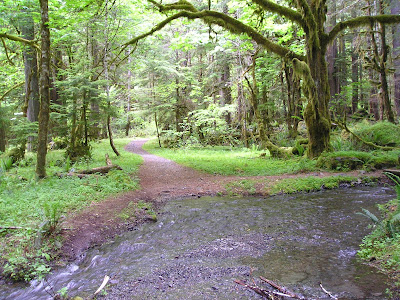


So until I get the report up, here are a few pictures:


Saturday, June 18, 2011
Prepping For The First Backpacking Trip of 2011
I'm taking a break from stuffing stuff sacks, rinsing water filters, consolidating food into minimal packaging, and sorting out who ends up carrying what. I am reminded that our camping french press that served us well for several years cracked last season and has not yet been replaced. I'm also disappointed to learn that I cannot locate my headlamp. I know I used it in recent months for getting firewood for the woodstove, but it is not where I thought I left it and has not turned up in the 37 other places I thought it might be. Frustrating.
The weather today is wet and grey, but I've been watching the forecast closely and the next few days promise decent weather. The plan is to head out to Staircase in the Olympic National Park and hike up the North Fork of the Skokomish Trail. After consideration it was agreed that excursions around Mt. Rainier would wait until later in the summer.
I am looking forward to bringing my new Vibram Fiver-Finger shoes for camp shoes, river fords, and such. I love my Teva's which have taken this role in the past, but the Five-Fingers are so much lighter and will certainly give me better traction in the water. I also have a new sun/hiking hat I picked up at the big annual REI sale. This will be my son's first camping trip with his headlamp that he got for his birthday (I wish I knew where mine was...).
I have the SPOT set up to let our family know we're okay while we're away. There's still a lot to do. I should get to it...
The weather today is wet and grey, but I've been watching the forecast closely and the next few days promise decent weather. The plan is to head out to Staircase in the Olympic National Park and hike up the North Fork of the Skokomish Trail. After consideration it was agreed that excursions around Mt. Rainier would wait until later in the summer.
I am looking forward to bringing my new Vibram Fiver-Finger shoes for camp shoes, river fords, and such. I love my Teva's which have taken this role in the past, but the Five-Fingers are so much lighter and will certainly give me better traction in the water. I also have a new sun/hiking hat I picked up at the big annual REI sale. This will be my son's first camping trip with his headlamp that he got for his birthday (I wish I knew where mine was...).
I have the SPOT set up to let our family know we're okay while we're away. There's still a lot to do. I should get to it...
Thursday, June 16, 2011
Japanese Researcher Creates Artificial Meat From Human Feces
The fact that someone would even consider doing this just shows where our food system is headed.
POOP BURGER: Japanese Researcher Creates Artificial Meat From Human Feces
by Lori Zimmer, 06/15/11
Some hardcore carnivores have a hard time finding meat alternatives such as soy protein or tofu burgers to be palatable. But non-meat eaters may lose their appetite along with their carnivorous friends over this one – a meat alternative made from HUMAN EXCREMENT. Yep, you heard me correctly — Japanese scientist Mitsuyuki Ikeda has developed a “burger” made from soya, steak sauce essence, and protein extracted from human feces.
[READ THE ORIGINAL ARTICLE HERE]
POOP BURGER: Japanese Researcher Creates Artificial Meat From Human Feces
by Lori Zimmer, 06/15/11
Some hardcore carnivores have a hard time finding meat alternatives such as soy protein or tofu burgers to be palatable. But non-meat eaters may lose their appetite along with their carnivorous friends over this one – a meat alternative made from HUMAN EXCREMENT. Yep, you heard me correctly — Japanese scientist Mitsuyuki Ikeda has developed a “burger” made from soya, steak sauce essence, and protein extracted from human feces.
[READ THE ORIGINAL ARTICLE HERE]
Gay Marriage
Why is gay marriage a huge pubic issue of debate but no one seems to care that any hedonistic pagan can become an ordained minister and perform legal weddings? Kevin Smith, the creator of films like Dogma and Zack and Miri Make A Porno, performs weddings at his podcast theater.
Don't get me wrong, I'm fine with it. What I don't understand is the uproar against who is getting married with no attention at all about who officiates the marriage.
Can you say, "double standard"? Doesn't matter.
Actually, none of it really matters, does it?
Don't get me wrong, I'm fine with it. What I don't understand is the uproar against who is getting married with no attention at all about who officiates the marriage.
Can you say, "double standard"? Doesn't matter.
Actually, none of it really matters, does it?
Monday, June 13, 2011
Documentaries and the Truth We Can Still Tell (But for How Long?)
Documentaries and the Truth We Can Still Tell (But for How Long?)
by Vivian Norris, Phd, Based in Paris-Globalization Studies
Posted: 06/13/11 09:19 AM ET
There may be an awful lot of lawyer jokes out there but for more and more documentary filmmakers, the legal challenges they are up against when trying to tell a story are no laughing matter. Forty years after the initial publishing of The Pentagon Papers, the full truth about Vietnam is finally being released. Daniel Ellsberg has stated that what he did back then as an investigative journalist was actually legal. Today, post-9/11 and Patriot Act, not only would it be illegal, it would be much more difficult to find any published information at all. Some information has indeed disappeared completely. And for those wonderfully stubborn souls who keep searching for the truth and trying to get it out there in front of audiences, they often find themselves, especially in the US, attacked by layer upon layer of lawsuits funded by corporations with deep pockets.
Take the case of Bananas! and the hell the Swedish filmmaker Fredrik Gertten and his producer went through when putting on the screen the stories of workers who were "allegedly" suffering from infertility due to exposure to pesticides while employed by the biggest fruit company in the world. The well-known legal story of Joe Berlinger's never-ending battles with his film about Chevron's pollution and the health affects on people in the Ecuadorian Amazon, Crude, overshadowed his message at times. And some turn to fiction to avoid the lawsuits by making feature films such as Michael Clayton which refer to the wrongs of companies such as Monsanto. And the list seems to be growing longer. Documentary filmmakers have enough problems trying to find the money to get their films made, but adding to that the mountains of legal bills and the time-consuming reality of defending oneself and one's film from being sued, one imagines the corporations are hoping that the filmmakers will back down and their docs will disappear.
But they won't.
And that was obvious by the lineup at the Sex, Docs and Rock and Roll Festival and Market in Sheffield in the UK this past week. The screenings were full of both industry folks and regular folks and the conversations in the pubs afterwards showed that documentary film attacking serious subjects is alive and well. But will many of these docs go on to have a life on television and in cinemas?
In Europe, Asia and other parts of the world independent documentaries can find a home, on a national broadcaster, but when we hear the stories of the thousands of indie docs applying for small pools of funds, the only reason they end up being made is because of the passion of the filmmakers.
People across the globe are indignant about everything from the deadly silence on Fukushima to the reality behind the BP disaster and how our health is being affected, and many recent documentary films are showing us why we should be. I argue we need these factual-based programs more than ever before and the stories they tell are more urgent and more dramatic than ever before. The subjects they deal with affect our lives, our children, our planet.
More foundations, film institutes, equity funds as well as more and less well known production companies such as Participant, are supporting "social issue" campaign-driven documentaries. But what can they do when a film they are supporting is attacked by a company which has endless cash to throw at some of the toughest law firms around?
They tell their stories anyway.
Brands are looking to documentary films as a way to help improve their corporate social responsibility image, and perhaps at times there are good "fits" between a company and the message in a doc beyond what might be considered to be "green-washing". But often this is not the case, take, for example, one doc about pollution and climate change released last year in France was supported by the same oil companies which seemed to be causing the problems being confronted in the film. The press exposed this hypocrisy and it lasted all of one week in the cinemas.
Taking this idea of brand support for a documentary to the extreme is Morgan Spurlock's Pom: The Greatest Film Ever Sold in which the filmmaker literally brands not only almost every scene in the film, he ends up branding his own body by wearing a suit covered by logos. We are bombarded by advertising more now than ever before, and the effects this is having on us and especially on our children, is disturbing. Spurlock travels to Sao Paolo in his film to show us what happens when people become fed up with swimming in Consumerstan, they simply ban advertising in all public spaces... the problem is, for much of the world, the privatization of what was once public has reached turbo speed.
How do you feel about visiting a national park and having your escape from it all experience sponsored by companies which want a piece of your down time? Would you sacrifice your integrity, or that of your family and community's common grounds to Starbucks, Wells Fargo and Coca Cola in order to keep services being cut because of the financial crisis? What about your children's school? A recent debate on the BBC over advertising in the classroom seemed quaint compared to what school districts are up against in the US. Spurlock's documentary shows one district in Florida in which administrators seem to be looking for ways to sell out to keep their schools able to offer the same things they did pre-crisis.
Have we already sold our souls to be branded? Have we started down that slippery slope, never to return to some kind of private sphere in which we remain protected from someone wanting to sell us something? Or have we all become as Roseanne Barr recently wrote in her magnificent diatribe about the media industry which is one of the most empowering pieces about the industry ever written. (Entitled "Fame's a Bitch, It's Hard to Handle Then It Drives You Nuts") in which she makes it extremely clear that there are no powerful people in television "... unless they work for an ad company or a market-study group. Those are the people who decide what gets on air and what doesn't."
And though this is not always the case in much of Europe, with its so-called bans on advertising, especially for children, and with its subsidies etc., it is a warning that if the private channels (or public channels which are acting like private channels, or yes, the monopolies owned by folks like Berlusconi or the near monopolies of Mr. Murdoch), don't watch out, there will be no truth told by documentary films, nor on the news, or very little of it and not the bits we need to know most. And we will have to either throw the television out the window and lose what could be one of the greatest most powerful forces of educational, entertaining good ever invented (though it seems the man who invented the television would not allow one in his home!).
Barr finds solace in the same words that documentary filmmakers trying to get the truth out there can find some comfort in, from Sun Tzu's Art of War, "He who cares the most, wins" -- but it does not pay the legal bills.
I agree with BBC's Nick Fraser that filmmakers should not risk their lives to make a film, and we spoke of a friend of his, the French filmmaker, Christian Poveda, who was killed when he returned to El Salvador to do a follow up on his powerful doc, Vida Loca. But perhaps that is indeed what they will find themselves doing as they work to tell the truth and penetrate the layers of corporate protection (someone please explain to me again why in the United States corporations are still given the same rights as human beings, in fact were given those rights before African Americans and women were?!). Why should filmmakers have to choose between life and truth?
If we lose the independence of the documentary voice, we have lost our freedom to know, to be informed, to look for and find knowledge which can help us as human beings, parts of communities, and as citizens of a world which needs us to know and to want to be curious about it.
Documentaries can be wonderful ways to lose ourselves in reality, not virtual reality, not reality tv, but "real" reality; they are not only enjoyable to watch, but because they are based on these facts, force us to question when we are fed lies. Good documentary filmmaking preserves our common human accomplishments and documents the natural world and ways of life (which in some cases sadly is disappearing. See a great doc about disappearing cowboys and shepherds in Montana called Sweetwater).
We don't want to find that documentary filmmaking has become extinct, or worse, that the truth is now inaccessible, privately owned by a tiny elite who can afford all those lawyers. I would hate to think that if we do not support documentary filmmakers, or worse, ignore their work, because it challenges us, that they may one day stop challenging us at all and will disappear from the party. If we, the audience, do not care, then nobody will. We need to notice. Because documentaries tell us who we are, what our world is about, and give us that Truth. Without this, you might as well throw your television out the window.
[READ THE ORIGINAL ARTICLE]
by Vivian Norris, Phd, Based in Paris-Globalization Studies
Posted: 06/13/11 09:19 AM ET
There may be an awful lot of lawyer jokes out there but for more and more documentary filmmakers, the legal challenges they are up against when trying to tell a story are no laughing matter. Forty years after the initial publishing of The Pentagon Papers, the full truth about Vietnam is finally being released. Daniel Ellsberg has stated that what he did back then as an investigative journalist was actually legal. Today, post-9/11 and Patriot Act, not only would it be illegal, it would be much more difficult to find any published information at all. Some information has indeed disappeared completely. And for those wonderfully stubborn souls who keep searching for the truth and trying to get it out there in front of audiences, they often find themselves, especially in the US, attacked by layer upon layer of lawsuits funded by corporations with deep pockets.
Take the case of Bananas! and the hell the Swedish filmmaker Fredrik Gertten and his producer went through when putting on the screen the stories of workers who were "allegedly" suffering from infertility due to exposure to pesticides while employed by the biggest fruit company in the world. The well-known legal story of Joe Berlinger's never-ending battles with his film about Chevron's pollution and the health affects on people in the Ecuadorian Amazon, Crude, overshadowed his message at times. And some turn to fiction to avoid the lawsuits by making feature films such as Michael Clayton which refer to the wrongs of companies such as Monsanto. And the list seems to be growing longer. Documentary filmmakers have enough problems trying to find the money to get their films made, but adding to that the mountains of legal bills and the time-consuming reality of defending oneself and one's film from being sued, one imagines the corporations are hoping that the filmmakers will back down and their docs will disappear.
But they won't.
And that was obvious by the lineup at the Sex, Docs and Rock and Roll Festival and Market in Sheffield in the UK this past week. The screenings were full of both industry folks and regular folks and the conversations in the pubs afterwards showed that documentary film attacking serious subjects is alive and well. But will many of these docs go on to have a life on television and in cinemas?
In Europe, Asia and other parts of the world independent documentaries can find a home, on a national broadcaster, but when we hear the stories of the thousands of indie docs applying for small pools of funds, the only reason they end up being made is because of the passion of the filmmakers.
People across the globe are indignant about everything from the deadly silence on Fukushima to the reality behind the BP disaster and how our health is being affected, and many recent documentary films are showing us why we should be. I argue we need these factual-based programs more than ever before and the stories they tell are more urgent and more dramatic than ever before. The subjects they deal with affect our lives, our children, our planet.
More foundations, film institutes, equity funds as well as more and less well known production companies such as Participant, are supporting "social issue" campaign-driven documentaries. But what can they do when a film they are supporting is attacked by a company which has endless cash to throw at some of the toughest law firms around?
They tell their stories anyway.
Brands are looking to documentary films as a way to help improve their corporate social responsibility image, and perhaps at times there are good "fits" between a company and the message in a doc beyond what might be considered to be "green-washing". But often this is not the case, take, for example, one doc about pollution and climate change released last year in France was supported by the same oil companies which seemed to be causing the problems being confronted in the film. The press exposed this hypocrisy and it lasted all of one week in the cinemas.
Taking this idea of brand support for a documentary to the extreme is Morgan Spurlock's Pom: The Greatest Film Ever Sold
in which the filmmaker literally brands not only almost every scene in the film, he ends up branding his own body by wearing a suit covered by logos. We are bombarded by advertising more now than ever before, and the effects this is having on us and especially on our children, is disturbing. Spurlock travels to Sao Paolo in his film to show us what happens when people become fed up with swimming in Consumerstan, they simply ban advertising in all public spaces... the problem is, for much of the world, the privatization of what was once public has reached turbo speed.How do you feel about visiting a national park and having your escape from it all experience sponsored by companies which want a piece of your down time? Would you sacrifice your integrity, or that of your family and community's common grounds to Starbucks, Wells Fargo and Coca Cola in order to keep services being cut because of the financial crisis? What about your children's school? A recent debate on the BBC over advertising in the classroom seemed quaint compared to what school districts are up against in the US. Spurlock's documentary shows one district in Florida in which administrators seem to be looking for ways to sell out to keep their schools able to offer the same things they did pre-crisis.
Have we already sold our souls to be branded? Have we started down that slippery slope, never to return to some kind of private sphere in which we remain protected from someone wanting to sell us something? Or have we all become as Roseanne Barr recently wrote in her magnificent diatribe about the media industry which is one of the most empowering pieces about the industry ever written. (Entitled "Fame's a Bitch, It's Hard to Handle Then It Drives You Nuts") in which she makes it extremely clear that there are no powerful people in television "... unless they work for an ad company or a market-study group. Those are the people who decide what gets on air and what doesn't."
And though this is not always the case in much of Europe, with its so-called bans on advertising, especially for children, and with its subsidies etc., it is a warning that if the private channels (or public channels which are acting like private channels, or yes, the monopolies owned by folks like Berlusconi or the near monopolies of Mr. Murdoch), don't watch out, there will be no truth told by documentary films, nor on the news, or very little of it and not the bits we need to know most. And we will have to either throw the television out the window and lose what could be one of the greatest most powerful forces of educational, entertaining good ever invented (though it seems the man who invented the television would not allow one in his home!).
Barr finds solace in the same words that documentary filmmakers trying to get the truth out there can find some comfort in, from Sun Tzu's Art of War, "He who cares the most, wins" -- but it does not pay the legal bills.
I agree with BBC's Nick Fraser that filmmakers should not risk their lives to make a film, and we spoke of a friend of his, the French filmmaker, Christian Poveda, who was killed when he returned to El Salvador to do a follow up on his powerful doc, Vida Loca. But perhaps that is indeed what they will find themselves doing as they work to tell the truth and penetrate the layers of corporate protection (someone please explain to me again why in the United States corporations are still given the same rights as human beings, in fact were given those rights before African Americans and women were?!). Why should filmmakers have to choose between life and truth?
If we lose the independence of the documentary voice, we have lost our freedom to know, to be informed, to look for and find knowledge which can help us as human beings, parts of communities, and as citizens of a world which needs us to know and to want to be curious about it.
Documentaries can be wonderful ways to lose ourselves in reality, not virtual reality, not reality tv, but "real" reality; they are not only enjoyable to watch, but because they are based on these facts, force us to question when we are fed lies. Good documentary filmmaking preserves our common human accomplishments and documents the natural world and ways of life (which in some cases sadly is disappearing. See a great doc about disappearing cowboys and shepherds in Montana called Sweetwater).
We don't want to find that documentary filmmaking has become extinct, or worse, that the truth is now inaccessible, privately owned by a tiny elite who can afford all those lawyers. I would hate to think that if we do not support documentary filmmakers, or worse, ignore their work, because it challenges us, that they may one day stop challenging us at all and will disappear from the party. If we, the audience, do not care, then nobody will. We need to notice. Because documentaries tell us who we are, what our world is about, and give us that Truth. Without this, you might as well throw your television out the window.
[READ THE ORIGINAL ARTICLE]
Saturday, June 11, 2011
Thursday, June 9, 2011
What the White House Garden Would Look Like If They Followed Their Own Ag Policy
I got this from OrganicConsumers.org. It references Kitchen Gardeners International, but I was unable to find these illustrations on that website.


What the White House Garden Would Look Like If They Followed Their Own Ag Policy
Thanks to Roger Doiron of Kitchen Gardeners International, a Maine-based nonprofit, for putting together these great visual aids. He writes:
In a nutshell, I was really inspired by the diversity and nutritiousness of the crops planted in the White House kitchen garden this spring and thought it would be eye-opening - not to mention jaw-dropping - to see what the White House garden would look like if it were planted to reflect the relative importance of the crops that our tax dollars are actually supporting.
You'll see that there's very little resemblance between America's Kitchen Garden and our "Subsidy Garden"
Food Mill
The food mill arrived yesterday. Today I went to the produce stand and spent most of the afternoon in the kitchen. My taste for hot pepper sauce has been ramping up over the past year or so. I figured it was time to learn to make it myself and it would be a great project for the new food mill.
A quick aside here... why make a condiment that I could find in a multitude of varieties in any grocery store? There are a number of reasons, but for me the primary reason is to be more connected to my own food supply. I appreciate knowing exactly what goes into what I am eating beyond a list of ingredients that include chemicals that I have to look up what they are and how to pronounce their names and can't find in any store. I like knowing (and being able to control) just how much sugar, salt, fat, etc. is going into my food (and my body, and my family's bodies). It's rewarding to learn how to make things like condiments and maybe even tweak the recipe to make it better. I am able to use fresh ingredients, know their origin, and deal with waste responsibly (i.e. chicken food and compost). On top of all of that, by doing it myself I take a lot of excess out of the equation such as the processing plant, warehousing, distribution, and advertising. Ultimately, I am able to produce a superior product that is healthier for me, my family, and the planet, and save money. The downside is that I have to take some time out every now and then and do it. It's worth it to me.
Back to today's project: hot pepper sauce! The produce stand had approximately seven pounds of various peppers on the discount table, so I bought them all, along with a couple heads of garlic (they were 2 for $1 and I know we'll use it). At home I cleaned the peppers, cut them up, and started trying to process them through the food mill. I thought I could process them through the coarse plate and then process the mash a second time through a more refined plate. It quickly became evident that I had not properly prepared the peppers for the food mill.
I decided to run the chopped peppers through the food processor first, then through the food mill. That worked out well, though it added a step I had hoped to eliminate. Once all the peppers (and a couple cloves of garlic) had been reduced to liquid, I added an (approximately) equal amount of vinegar and seven teaspoons of salt. After stirring the solution well, I gave the spoon a conservative taste test and was very happy with the result! I brought the sauce to a gradual boil while I sterilized some pint jars and lids.
I ultimately ended up with five pints of hot pepper sauce. Every recipe I read said that it needs to ferment for at least two weeks, up to three months (or more). At this point the jars have cooled and the vinegar and pepper juice seems to have separated, but a quick shake appears to solve the separation.
I'll follow up on the pepper sauce experiment as it progresses. I think I might try steaming them first next time. I am really looking forward to making spaghetti sauce when the local tomatoes start coming in!
A quick aside here... why make a condiment that I could find in a multitude of varieties in any grocery store? There are a number of reasons, but for me the primary reason is to be more connected to my own food supply. I appreciate knowing exactly what goes into what I am eating beyond a list of ingredients that include chemicals that I have to look up what they are and how to pronounce their names and can't find in any store. I like knowing (and being able to control) just how much sugar, salt, fat, etc. is going into my food (and my body, and my family's bodies). It's rewarding to learn how to make things like condiments and maybe even tweak the recipe to make it better. I am able to use fresh ingredients, know their origin, and deal with waste responsibly (i.e. chicken food and compost). On top of all of that, by doing it myself I take a lot of excess out of the equation such as the processing plant, warehousing, distribution, and advertising. Ultimately, I am able to produce a superior product that is healthier for me, my family, and the planet, and save money. The downside is that I have to take some time out every now and then and do it. It's worth it to me.
Back to today's project: hot pepper sauce! The produce stand had approximately seven pounds of various peppers on the discount table, so I bought them all, along with a couple heads of garlic (they were 2 for $1 and I know we'll use it). At home I cleaned the peppers, cut them up, and started trying to process them through the food mill. I thought I could process them through the coarse plate and then process the mash a second time through a more refined plate. It quickly became evident that I had not properly prepared the peppers for the food mill.
I decided to run the chopped peppers through the food processor first, then through the food mill. That worked out well, though it added a step I had hoped to eliminate. Once all the peppers (and a couple cloves of garlic) had been reduced to liquid, I added an (approximately) equal amount of vinegar and seven teaspoons of salt. After stirring the solution well, I gave the spoon a conservative taste test and was very happy with the result! I brought the sauce to a gradual boil while I sterilized some pint jars and lids.
I ultimately ended up with five pints of hot pepper sauce. Every recipe I read said that it needs to ferment for at least two weeks, up to three months (or more). At this point the jars have cooled and the vinegar and pepper juice seems to have separated, but a quick shake appears to solve the separation.
I'll follow up on the pepper sauce experiment as it progresses. I think I might try steaming them first next time. I am really looking forward to making spaghetti sauce when the local tomatoes start coming in!
Wednesday, June 8, 2011
Regulators Knew World's Best-Selling Herbicide Causes Problems, New Report Finds
Sadly, this doesn't surprise me at all...
Roundup Birth Defects: Regulators Knew World's Best-Selling Herbicide Causes Problems, New Report Finds
Lucia Graves
lucia@huffingtonpost.com
First Posted: 06/ 7/11 07:48 PM ET Updated: 06/ 8/11 05:36 PM ET
WASHINGTON -- Industry regulators have known for years that Roundup, the world's best-selling herbicide produced by U.S. company Monsanto, causes birth defects, according to a new report released Tuesday.
The report, "Roundup and birth defects: Is the public being kept in the dark?" found regulators knew as long ago as 1980 that glyphosate, the chemical on which Roundup is based, can cause birth defects in laboratory animals.
But despite such warnings, and although the European Commission has known that glyphosate causes malformations since at least 2002, the information was not made public.
Instead regulators misled the public about glyphosate's safety, according to the report, and as recently as last year, the German Federal Office for Consumer Protection and Food Safety, the German government body dealing with the glyphosate review, told the European Commission that there was no evidence glyphosate causes birth defects.
The report comes months after researchers found that genetically-modified crops used in conjunction Roundup contain a pathogen that may cause animal miscarriages. After observing the newly discovered organism back in February, Don Huber, an emeritus professor at Purdue University, wrote an open letter to Secretary of Agriculture Tom Vilsack requesting a moratorium on deregulating crops genetically altered to be immune to Roundup, which are commonly called Roundup Ready crops.
In the letter, Huber also commented on the herbicide itself, saying: "It is well-documented that glyphosate promotes soil pathogens and is already implicated with the increase of more than 40 plant diseases; it dismantles plant defenses by chelating vital nutrients; and it reduces the bioavailability of nutrients in feed, which in turn can cause animal disorders."
Although glyphosate was originally due to be reviewed in 2012, the Commission decided late last year not to bring the review forward, instead delaying it until 2015. The chemical will not be reviewed under more stringent, up-to-date standards until 2030.
"Our examination of the evidence leads us to the conclusion that the current approval of glyphosate and Roundup is deeply flawed and unreliable," wrote the report authors in their conclusion. "What is more, we have learned from experts familiar with pesticide assessments and approvals that the case of glyphosate is not unusual.
"They say that the approvals of numerous pesticides rest on data and risk assessments that are just as scientifically flawed, if not more so," the authors added. "This is all the more reason why the Commission must urgently review glyphosate and other pesticides according to the most rigorous and up-to-date standards."
[READ THE ORIGINAL ARTICLE]
Roundup Birth Defects: Regulators Knew World's Best-Selling Herbicide Causes Problems, New Report Finds
Lucia Graves
lucia@huffingtonpost.com
First Posted: 06/ 7/11 07:48 PM ET Updated: 06/ 8/11 05:36 PM ET
WASHINGTON -- Industry regulators have known for years that Roundup, the world's best-selling herbicide produced by U.S. company Monsanto, causes birth defects, according to a new report released Tuesday.
The report, "Roundup and birth defects: Is the public being kept in the dark?" found regulators knew as long ago as 1980 that glyphosate, the chemical on which Roundup is based, can cause birth defects in laboratory animals.
But despite such warnings, and although the European Commission has known that glyphosate causes malformations since at least 2002, the information was not made public.
Instead regulators misled the public about glyphosate's safety, according to the report, and as recently as last year, the German Federal Office for Consumer Protection and Food Safety, the German government body dealing with the glyphosate review, told the European Commission that there was no evidence glyphosate causes birth defects.
The report comes months after researchers found that genetically-modified crops used in conjunction Roundup contain a pathogen that may cause animal miscarriages. After observing the newly discovered organism back in February, Don Huber, an emeritus professor at Purdue University, wrote an open letter to Secretary of Agriculture Tom Vilsack requesting a moratorium on deregulating crops genetically altered to be immune to Roundup, which are commonly called Roundup Ready crops.
In the letter, Huber also commented on the herbicide itself, saying: "It is well-documented that glyphosate promotes soil pathogens and is already implicated with the increase of more than 40 plant diseases; it dismantles plant defenses by chelating vital nutrients; and it reduces the bioavailability of nutrients in feed, which in turn can cause animal disorders."
Although glyphosate was originally due to be reviewed in 2012, the Commission decided late last year not to bring the review forward, instead delaying it until 2015. The chemical will not be reviewed under more stringent, up-to-date standards until 2030.
"Our examination of the evidence leads us to the conclusion that the current approval of glyphosate and Roundup is deeply flawed and unreliable," wrote the report authors in their conclusion. "What is more, we have learned from experts familiar with pesticide assessments and approvals that the case of glyphosate is not unusual.
"They say that the approvals of numerous pesticides rest on data and risk assessments that are just as scientifically flawed, if not more so," the authors added. "This is all the more reason why the Commission must urgently review glyphosate and other pesticides according to the most rigorous and up-to-date standards."
[READ THE ORIGINAL ARTICLE]
Spring Cleaning!
The weather on Sunday and Monday was warm and sunny. The locals news even reported that the weather was the warmest it had been since September. It’s been a long winter…
As much as I would have liked to load up the backpacks and spend the weekend with the family out in the wilderness, there were priorities at home. The wife got her serger back from the shop a little while back and her mom brought us the table that goes with her new sewing machine just last week. We finally got all of the files transferred from my wife’s old desktop PC and were ready to take it apart and rearrange some things. We moved the nice computer desk from the living room to the office and donated the desk from the office to the local thrift store. The new desktop set up is using the most efficient components from each of the old set ups. Now that the entire family has graduated to laptops, I expect the desktop probably won't see a lot of use.
Where the desk was in the living room we set up the sewing table, craft table from the office, and other crafty stuff scattered throughout the house. While we were at it we rearranged the rest of the living room furniture. Now the office is back to being a dedicated office and my wife has a functional craft space in the main living area.
In the course of all of the moving and rearranging we were able to do a lot of spring cleaning. We opened all the windows and cleaned as we went along. We also thinned out a lot of stuff to donate, freecycle, and trade at the used bookstore.
One reason we weren’t able to take a trip was because I had a work meeting scheduled for Sunday afternoon. While I did that my wife went out and picked up some tomato and pepper plants for the garden. We have a few starts from the heirloom seeds, but with the season getting such a late start we agreed we needed something further along if we were going to have much of a harvest. She also cleaned up the kitchen!
After getting the office and living room rearranged we decided to focus on a few organization issues. The first part of Monday we spent running errands. We traded in some old books at the used bookstore (I picked up a 1st Edition copy of Fawn Brodie’s, Thomas Jefferson, an Intimate History. Inside was an old postcard from Monticello the previous owner had been using for a bookmark!), returned and picked up some things at the library, dropped off another load of stuff at the thrift store, and found a small bookshelf for the living room and a large bookshelf for the office at the local consignment shop.
After cleaning the shelves and setting them up at home, we set out for the second round of errands. We stopped by the post office to mail a bunch of kid’s videos back to the friend who loaned them to us. We had a gift card for a big-box store, so we went in seeking some organizational help. We found some bed risers to create storage space under our son’s bed, magazine holders, a file box for our son’s extensive collection of Lego building instructions and magazines, and a set of stainless steel measuring cups to replace our plastic ones. After tax we had $0.31 left on the card. Dang near perfect! From there we stocked up on some things at Costco (most noteworthy – Costco had recycled bath tissue for the first time! We’re set for months now).
When we got home we put the food away, put our son’s bed on risers, reorganized the books and magazines, and I spent some time rewiring and organizing the office.
Today the weather took a turn. It was cold and wet. I made a run to the butcher store and produce stand and then spent most of the afternoon in the kitchen. Our most recent order from Amazon arrived this afternoon as well.
I may have to go back to the produce stand tomorrow and get something to run through the food mill …
…
As much as I would have liked to load up the backpacks and spend the weekend with the family out in the wilderness, there were priorities at home. The wife got her serger back from the shop a little while back and her mom brought us the table that goes with her new sewing machine just last week. We finally got all of the files transferred from my wife’s old desktop PC and were ready to take it apart and rearrange some things. We moved the nice computer desk from the living room to the office and donated the desk from the office to the local thrift store. The new desktop set up is using the most efficient components from each of the old set ups. Now that the entire family has graduated to laptops, I expect the desktop probably won't see a lot of use.
Where the desk was in the living room we set up the sewing table, craft table from the office, and other crafty stuff scattered throughout the house. While we were at it we rearranged the rest of the living room furniture. Now the office is back to being a dedicated office and my wife has a functional craft space in the main living area.
In the course of all of the moving and rearranging we were able to do a lot of spring cleaning. We opened all the windows and cleaned as we went along. We also thinned out a lot of stuff to donate, freecycle, and trade at the used bookstore.
One reason we weren’t able to take a trip was because I had a work meeting scheduled for Sunday afternoon. While I did that my wife went out and picked up some tomato and pepper plants for the garden. We have a few starts from the heirloom seeds, but with the season getting such a late start we agreed we needed something further along if we were going to have much of a harvest. She also cleaned up the kitchen!
After getting the office and living room rearranged we decided to focus on a few organization issues. The first part of Monday we spent running errands. We traded in some old books at the used bookstore (I picked up a 1st Edition copy of Fawn Brodie’s, Thomas Jefferson, an Intimate History. Inside was an old postcard from Monticello the previous owner had been using for a bookmark!), returned and picked up some things at the library, dropped off another load of stuff at the thrift store, and found a small bookshelf for the living room and a large bookshelf for the office at the local consignment shop.
After cleaning the shelves and setting them up at home, we set out for the second round of errands. We stopped by the post office to mail a bunch of kid’s videos back to the friend who loaned them to us. We had a gift card for a big-box store, so we went in seeking some organizational help. We found some bed risers to create storage space under our son’s bed, magazine holders, a file box for our son’s extensive collection of Lego building instructions and magazines, and a set of stainless steel measuring cups to replace our plastic ones. After tax we had $0.31 left on the card. Dang near perfect! From there we stocked up on some things at Costco (most noteworthy – Costco had recycled bath tissue for the first time! We’re set for months now).
When we got home we put the food away, put our son’s bed on risers, reorganized the books and magazines, and I spent some time rewiring and organizing the office.
Today the weather took a turn. It was cold and wet. I made a run to the butcher store and produce stand and then spent most of the afternoon in the kitchen. Our most recent order from Amazon arrived this afternoon as well.
I may have to go back to the produce stand tomorrow and get something to run through the food mill
…
Subscribe to:
Posts (Atom)