Thursday, July 7, 2011


Monday, July 4, 2011
July 4th
235 years ago a group of American rebels adopted a document that started like this:
When, in the course of human events, it becomes necessary for one people to dissolve the political bands which have connected them with another, and to assume among the powers of the earth, the separate and equal station to which the laws of nature and of nature's God entitle them, a decent respect to the opinions of mankind requires that they should declare the causes which impel them to the separation.
We hold these truths to be self-evident, that all men are created equal, that they are endowed by their Creator with certain unalienable rights, that among these are life, liberty and the pursuit of happiness. That to secure these rights, governments are instituted among men, deriving their just powers from the consent of the governed. That whenever any form of government becomes destructive to these ends, it is the right of the people to alter or to abolish it, and to institute new government, laying its foundation on such principles and organizing its powers in such form, as to them shall seem most likely to effect their safety and happiness. Prudence, indeed, will dictate that governments long established should not be changed for light and transient causes; and accordingly all experience hath shown that mankind are more disposed to suffer, while evils are sufferable, than to right themselves by abolishing the forms to which they are accustomed. But when a long train of abuses and usurpations, pursuing invariably the same object evinces a design to reduce them under absolute despotism, it is their right, it is their duty, to throw off such government, and to provide new guards for their future security...

When, in the course of human events, it becomes necessary for one people to dissolve the political bands which have connected them with another, and to assume among the powers of the earth, the separate and equal station to which the laws of nature and of nature's God entitle them, a decent respect to the opinions of mankind requires that they should declare the causes which impel them to the separation.
We hold these truths to be self-evident, that all men are created equal, that they are endowed by their Creator with certain unalienable rights, that among these are life, liberty and the pursuit of happiness. That to secure these rights, governments are instituted among men, deriving their just powers from the consent of the governed. That whenever any form of government becomes destructive to these ends, it is the right of the people to alter or to abolish it, and to institute new government, laying its foundation on such principles and organizing its powers in such form, as to them shall seem most likely to effect their safety and happiness. Prudence, indeed, will dictate that governments long established should not be changed for light and transient causes; and accordingly all experience hath shown that mankind are more disposed to suffer, while evils are sufferable, than to right themselves by abolishing the forms to which they are accustomed. But when a long train of abuses and usurpations, pursuing invariably the same object evinces a design to reduce them under absolute despotism, it is their right, it is their duty, to throw off such government, and to provide new guards for their future security...

Happy Independence Day!
On The Road: North Platte, Nebraska
I am currently in western Nebraska for a gig. I'll do a trip report after I get home, but I wanted to post about what my wife and I did today.
 We got in late after the gig last night, so we got a late start. I had the day off, so we decided to get lunch and explore North Platte, Nebraska. We started at Cody's Trading Post, an obvious tourist trap souvenir shop right off the interstate banking on the legend of Bill Cody's "Buffalo Bill's Wild West" show. There was a lot to look at, though, and it was fun. I picked up a book called, The Wisdom of the Native Americans
 , a couple things for the boy (who is stay with grandma in Colorado while we're here), and the wife picked up a souvenir sticker.
 From there we drove out to the northwest edge of town to visit the Golden Spike Tower overlooking Union Pacific's Bailey Train Yard. At two miles wide and eight miles long, Bailey is the largest train yard in the world. The Golden Spike Tower has an open-air observation deck on the seventh floor and a glassed-in, 360-degree viewing area on the eighth floor overlooking the whole operation. The whole thing is very impressive.
 While we were looking around the eighth-floor viewing area, I came across a brochure for area attractions. My wife spotted Dancing Leaf Cultural Learning Center in Wellfleet. After looking up the location of Wellfleet -- about 25 miles south of North Platte -- we called to see what their hours were. The woman on the phone was happy to give us any information we needed and effectively told us to show up and we would get the tour whenever we arrived. We were even offered to join an earlier group for some traditional native buffalo stew, but we were still full from our late lunch.
 We arrived at Dancing Leaf and were greeted by Les and Jan Hosick. After a quick round of introductions and the obligatory explanation of why were hanging out in North Platte, Les took us to a small building across the driveway from their home. I'll admit, as we walked into the the single-room box with a single row of metal folding chairs and shelves covered with bones and artifacts I wondered if this might turn out to be disappointing. After only a few minutes of listening to Les talk about prehistoric Nebraska I was completely sucked in. He told us about prehistoric geography and why so many artifacts can be found in Nebraska using charts, maps, fossils, bones, and plaster casts. He went on to discuss Native American culture and history with an impressive array of artifacts. After almost an hour of fascinating show& tell and Q&A, we took a short walk out of the classroom to the earth lodge Les has built as a recreation of an actual Native American lodge.
 Outside the lodge are primitive racks for drying and tanning, an arbor of limbs and twigs to form a shaded work area, campfire, and a whole new assortment of artifacts to recreate the entire native family home. Inside the lodge was amazing! While Les admitted to using modern hand-tools -- he spoke quite a bit about the fragility of tools made from stone, sticks, and bones and the need for native peoples to be skilled in tool making -- the lodge is an authentic replica. The temperature inside was probably 15 degrees (fahrenheit) cooler than outside. We sat inside around the fire ring and Les told us about family life in and around the lodge and about construction of the lodge itself.
 By the time we made our way back to the gift shop Les had spent close to two hours with my wife and I and every minute was riveting. I picked up an arrowhead necklace for a souvenir and also picked up a book, How Can One Sell The Air?
 , a study of a speech by Chief Seattle.
"Wild Bill" Cody, the world's largest train yard, and the coolest history field-trip ever. We didn't even make it to Buffalo Bill's Ranch. North Platte, Nebraska is a pretty cool place!
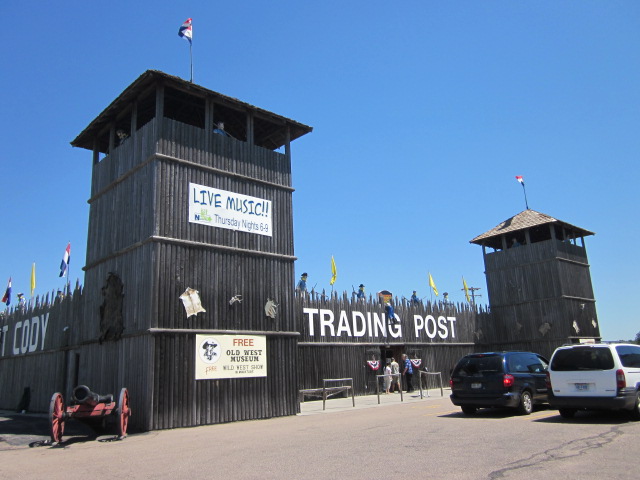 , a couple things for the boy (who is stay with grandma in Colorado while we're here), and the wife picked up a souvenir sticker.


 Outside the lodge are primitive racks for drying and tanning, an arbor of limbs and twigs to form a shaded work area, campfire, and a whole new assortment of artifacts to recreate the entire native family home. Inside the lodge was amazing! While Les admitted to using modern hand-tools -- he spoke quite a bit about the fragility of tools made from stone, sticks, and bones and the need for native peoples to be skilled in tool making -- the lodge is an authentic replica. The temperature inside was probably 15 degrees (fahrenheit) cooler than outside. We sat inside around the fire ring and Les told us about family life in and around the lodge and about construction of the lodge itself.
 , a study of a speech by Chief Seattle.
"Wild Bill" Cody, the world's largest train yard, and the coolest history field-trip ever. We didn't even make it to Buffalo Bill's Ranch. North Platte, Nebraska is a pretty cool place!
Thursday, June 30, 2011
TIME Article on Elizabeth Warren
From Time.com:
Elizabethan Drama
By MICHAEL CROWLEY Thursday, June 30, 2011
Here's some good news for consumers who feel themselves trampled by soulless banking and credit giants: on July 21, a new consumer-protection agency will open its doors in Washington, with the mission of making everything from mortgage documents to credit statements fairer and easier to understand and generally giving the little guy more power against the financial corporate juggernauts.
Here's the bad news: it's not clear that President Obama will be able to appoint anyone to run it.
It's an unexpected twist to a larger Obama policy achievement that has been slowly unraveling in recent months. Last July, Obama signed a sweeping bill, passed by the Democratic Congress, that overhauled Washington's regulation of Wall Street banks and other financial-services companies whose greed and risk taking helped wreck the U.S. economy. The idea was to prevent another financial crisis through tighter rules and closer supervision. A year later, Obama is fighting off emboldened Republicans who — backed by Wall Street money and lobbyists — are trying to gut the measure. The battle is raging mostly out of public view, in the realm of regulators and budgetmakers.
(See TIME's cover story: "The New Sheriffs of Wall Street.")
But a more visible showdown is unfolding over what some advocates say is the best feature of the Wall Street reform bill: a new Consumer Financial Protection Bureau created to safeguard ordinary Americans from confusing, sneaky and downright dishonest tactics by the likes of banks, mortgage lenders and credit-card companies. Obama has hailed the office as "a new consumer watchdog with just one job: looking out for people — not big banks, not lenders, not investment houses ... as they interact with the financial system."
Now the fate of that watchdog is in doubt. At the center of the fight is Elizabeth Warren, a strong-willed Harvard Law professor who has become the most celebrated consumer advocate since Ralph Nader. Warren's supporters — and there are many, especially on the activist left — argue that she's the obvious choice to run the new bureau. In part that's because it's her brainchild: it was Warren who asked in a 2007 essay why consumers were protected from buying appliances with unseen faulty wiring that could burn down their homes but not from hidden terms, fees and risks that could sink their finances. Obama picked up her idea for a consumer-protection bureau and campaigned on it in 2008, even before the financial crisis gave the concept some urgency.
(See "The Elizabeth Warren Test.")
But Obama has yet to appoint Warren to the top job, and Republicans have long made clear that they will oppose Warren's appointment if he does. In May, they upped their ante. In a letter to Obama, 44 Senate Republicans — enough to filibuster any Senate action — declared that they would oppose any nominee to run the bureau unless Obama agreed to changes in its structure and funding. Democrats say those changes would effectively neuter the bureau and hand the financial industry yet another victory over the little guy.
That leaves Obama with three options, none of them appealing. He can muscle Warren into a short-term recess appointment this summer, an act sure to enrage Republicans and prevent Warren from serving a full term. He can officially nominate her, or someone else, and hope a public-relations effort will force the GOP to capitulate. Or he can try to cut a deal to sacrifice Warren but save her agency, which would surely disappoint his already restive liberal supporters. (One progressive group has warned that such a deal would show "complete and utter weakness.") At the moment, no one is sure what he'll do. Including Warren.
[READ THE REST OF THE ARTICLE HERE]
Elizabethan Drama
By MICHAEL CROWLEY Thursday, June 30, 2011
Here's some good news for consumers who feel themselves trampled by soulless banking and credit giants: on July 21, a new consumer-protection agency will open its doors in Washington, with the mission of making everything from mortgage documents to credit statements fairer and easier to understand and generally giving the little guy more power against the financial corporate juggernauts.
Here's the bad news: it's not clear that President Obama will be able to appoint anyone to run it.
It's an unexpected twist to a larger Obama policy achievement that has been slowly unraveling in recent months. Last July, Obama signed a sweeping bill, passed by the Democratic Congress, that overhauled Washington's regulation of Wall Street banks and other financial-services companies whose greed and risk taking helped wreck the U.S. economy. The idea was to prevent another financial crisis through tighter rules and closer supervision. A year later, Obama is fighting off emboldened Republicans who — backed by Wall Street money and lobbyists — are trying to gut the measure. The battle is raging mostly out of public view, in the realm of regulators and budgetmakers.
(See TIME's cover story: "The New Sheriffs of Wall Street.")
But a more visible showdown is unfolding over what some advocates say is the best feature of the Wall Street reform bill: a new Consumer Financial Protection Bureau created to safeguard ordinary Americans from confusing, sneaky and downright dishonest tactics by the likes of banks, mortgage lenders and credit-card companies. Obama has hailed the office as "a new consumer watchdog with just one job: looking out for people — not big banks, not lenders, not investment houses ... as they interact with the financial system."
Now the fate of that watchdog is in doubt. At the center of the fight is Elizabeth Warren, a strong-willed Harvard Law professor who has become the most celebrated consumer advocate since Ralph Nader. Warren's supporters — and there are many, especially on the activist left — argue that she's the obvious choice to run the new bureau. In part that's because it's her brainchild: it was Warren who asked in a 2007 essay why consumers were protected from buying appliances with unseen faulty wiring that could burn down their homes but not from hidden terms, fees and risks that could sink their finances. Obama picked up her idea for a consumer-protection bureau and campaigned on it in 2008, even before the financial crisis gave the concept some urgency.
(See "The Elizabeth Warren Test.")
But Obama has yet to appoint Warren to the top job, and Republicans have long made clear that they will oppose Warren's appointment if he does. In May, they upped their ante. In a letter to Obama, 44 Senate Republicans — enough to filibuster any Senate action — declared that they would oppose any nominee to run the bureau unless Obama agreed to changes in its structure and funding. Democrats say those changes would effectively neuter the bureau and hand the financial industry yet another victory over the little guy.
That leaves Obama with three options, none of them appealing. He can muscle Warren into a short-term recess appointment this summer, an act sure to enrage Republicans and prevent Warren from serving a full term. He can officially nominate her, or someone else, and hope a public-relations effort will force the GOP to capitulate. Or he can try to cut a deal to sacrifice Warren but save her agency, which would surely disappoint his already restive liberal supporters. (One progressive group has warned that such a deal would show "complete and utter weakness.") At the moment, no one is sure what he'll do. Including Warren.
[READ THE REST OF THE ARTICLE HERE]
Monsanto Under Federal Investigation For Cash Incentives Program
Monsanto Under Federal Investigation For Cash Incentives Program
by Lucia Graves
First Posted: 06/30/11 11:58 AM ET Updated: 06/30/11 02:07 PM ET
WASHINGTON -- Global agribusiness giant Monsanto is under federal investigation for using cash incentives to persuade distributors to use Roundup, the world's top-selling weedkiller.
Monsanto announced Wednesday the company would cooperate with the Securities and Exchange Commission's probe of its "customer incentives" programs and a subpoena for documents pertaining to the sale of Monsanto's glyphosate products in fiscal years 2009 and 2010.
The US-based company has allegedly been offering distributors up to $20 per acre to use Roundup, as well as Roundup Ready seeds, which have been genetically modified to resist the glyphosate-based herbicide.
The announcement came as the agricultural biotechnology giant reported a 77 percent jump in net income, an increase attributed mostly to the strength of its core seeds and genetic traits businesses.
"We made significant changes to our business this year, and those changes resonated with our customers," said Hugh Grant, Monsanto's president and chief executive officer, in a statement. "We earned their business and achieved what we set out to achieve: unit volume growth in our core crops, a successful implementation of our agricultural productivity strategy and sustained cost-discipline across our operations. That positions us well for the coming years and the mid-teens earnings growth opportunity we see for this company."
Net income attributable to Monsanto Company for the third quarter, which ended on May 31, rose to $680 million at $1.26 per share, from $384 at 70 cents per share a year earlier.
The agribusiness giant also raised its full-year ongoing earnings guidance to $2.84 to $2.88 per share, from $2.72 to $2.82 per share
Net sales increased 21 percent, to $3.59 billion, up from $2.96 billion in 2010.
When questioned about the SEC's probe on a Wednesday conference call with reporters, Grant declined to comment in detail, but he assured reporters Monsanto was taking the investigation seriously.
“Out of respect for the SEC and their processes, there’s really not a great deal I can say at the moment,” said Grant, according to a report by the Associated Press. "It's focused on (Roundup) and it's focused on our customer incentives and it's focused on the 2009-2010 time frame, and we are - it's early days, but we are, we're just starting document production and we are cooperating to our full ability."
Monsanto is also currently being investigated by the U.S. Department of Justice for a possible violation of anti-trust laws regarding its dominance of the genetically-engineered seed industry.
by Lucia Graves
First Posted: 06/30/11 11:58 AM ET Updated: 06/30/11 02:07 PM ET
WASHINGTON -- Global agribusiness giant Monsanto is under federal investigation for using cash incentives to persuade distributors to use Roundup, the world's top-selling weedkiller.
Monsanto announced Wednesday the company would cooperate with the Securities and Exchange Commission's probe of its "customer incentives" programs and a subpoena for documents pertaining to the sale of Monsanto's glyphosate products in fiscal years 2009 and 2010.
The US-based company has allegedly been offering distributors up to $20 per acre to use Roundup, as well as Roundup Ready seeds, which have been genetically modified to resist the glyphosate-based herbicide.
The announcement came as the agricultural biotechnology giant reported a 77 percent jump in net income, an increase attributed mostly to the strength of its core seeds and genetic traits businesses.
"We made significant changes to our business this year, and those changes resonated with our customers," said Hugh Grant, Monsanto's president and chief executive officer, in a statement. "We earned their business and achieved what we set out to achieve: unit volume growth in our core crops, a successful implementation of our agricultural productivity strategy and sustained cost-discipline across our operations. That positions us well for the coming years and the mid-teens earnings growth opportunity we see for this company."
Net income attributable to Monsanto Company for the third quarter, which ended on May 31, rose to $680 million at $1.26 per share, from $384 at 70 cents per share a year earlier.
The agribusiness giant also raised its full-year ongoing earnings guidance to $2.84 to $2.88 per share, from $2.72 to $2.82 per share
Net sales increased 21 percent, to $3.59 billion, up from $2.96 billion in 2010.
When questioned about the SEC's probe on a Wednesday conference call with reporters, Grant declined to comment in detail, but he assured reporters Monsanto was taking the investigation seriously.
“Out of respect for the SEC and their processes, there’s really not a great deal I can say at the moment,” said Grant, according to a report by the Associated Press. "It's focused on (Roundup) and it's focused on our customer incentives and it's focused on the 2009-2010 time frame, and we are - it's early days, but we are, we're just starting document production and we are cooperating to our full ability."
Monsanto is also currently being investigated by the U.S. Department of Justice for a possible violation of anti-trust laws regarding its dominance of the genetically-engineered seed industry.
Tuesday, June 28, 2011
Headlamp: FOUND!
My missing headlamp (see Prepping For The First Backpacking Trip of 2011) was found last night! My wife found it in an old nap sack we had forgotten we had taken with us to Mt. Rainier. I had looked there, but I apparently missed a pocket.
Of course this comes the day we bought it's replacement.
Oh well, now we each have one and, to be honest, I'm glad we didn't get a less-expensive replacement because it's a good, versatile lamp.
We haven't replaced the french press. This last trip we took tea bags and single-serving coffee bags. It creates a little more waste to pack out, but it works for now and we can compost them when we get home.
We did get the wife new hiking boots and a new pack. Her old boots were cheap to begin with and pretty tired, but we've had a difficult time finding solid, affordable, comfortable boots for her. More or less the same story with the backpack. After the North Fork of the Skokomish trip we agreed to put the debt pay-down on hold for a moment and remedy those two issues. We took advantage of REI's Summer Sale and upgraded or replaced a few other items.
I can't wait for the next trip!
Where's my map?...
Of course this comes the day we bought it's replacement.
Oh well, now we each have one and, to be honest, I'm glad we didn't get a less-expensive replacement because it's a good, versatile lamp.
We haven't replaced the french press. This last trip we took tea bags and single-serving coffee bags. It creates a little more waste to pack out, but it works for now and we can compost them when we get home.
We did get the wife new hiking boots and a new pack. Her old boots were cheap to begin with and pretty tired, but we've had a difficult time finding solid, affordable, comfortable boots for her. More or less the same story with the backpack. After the North Fork of the Skokomish trip we agreed to put the debt pay-down on hold for a moment and remedy those two issues. We took advantage of REI's Summer Sale and upgraded or replaced a few other items.
I can't wait for the next trip!
Where's my map?...
Trip Report: Backpacking The North Fork of the Skokomish River. June 19-21, 2011

Sunday, June 19th. The forecast called for a 30% chance of rain until 4pm, so we didn't hurry as we got some coffee, loaded our packs into the car, and stopped for food on our way to the Olympic National Park. Our driving destination was Staricase, an area on the southeast corner of the park. The first year we moved to Washington we did most of our camping at Staircase and Big Creek nearby in the National Forest. (My hike up Mt. Ellinor started from Big Creek.) From there we would don our packs and hike four miles up the North Fork of the Skokomish River Trail to Spike Camp.
The weather was a bit overcast with highs in the low 60's. This was our first backpacking trip of the year and we were all out of shape after a long winter. My son was not thrilled about the four-mile hike with a pack on his back. I wish we could have worked up to it and done a few warm-up hikes, but the weather has been awful and we've been so busy. The first day is always the hardest.

When we arrived at Spike Camp we still had plenty of daylight, so we took our time setting up. Before I had the tent up our son had rebounded from his misery and was bouncing off the trees. We set up the tent, sleeping bags, filtered water, built a fire, had some food and drink, and were almost ready to call it a day before the sun went down. I was able to start the fire without a match using tinder from the area, a small bit of tissue, some magnesium, and a flint.
I had traded my hiking boots for my new Vibram Five-Finger barefoot shoes
 as soon as we arrived and they were a welcome change. In fact, the only downside to the barefoot shoes I noted on this trip is that they are not warm on a chilly night. The Tevas aren't warm, either, but it possible to put on a pair of wool socks with the Tevas. Not so much with the barefoot shoes. Still, I think the barefoot shoes will continue to be a part of my warm weather backpacking gear.
Monday, June 20th. That night, for whatever reason, we all woke up during the night and had a difficult time getting back to sleep. As a result, it was 10am before we got up the next day. After some coffee and a bit of food, we took down camp, packed up, and headed up the trail just before noon. It was mostly cloudy with a high in the low 60's. We filtered some water on our way out since the nearest water source is a little way up the trail. Our plan for today was flexible -- we would hike up to the next camp which is Big Log and at that point decide if we wanted to stay there or continue on to Camp Pleasant.

We got to the spur for Big Log and the sign said Camp Pleasant was only 1.4 miles further. We agreed to press on.
There were three major creek/river crossings along the way: Madeline Creek, Donahue Creek, and the Skokomish River itself. The Donahue crossing was no problem as there was a log bridge over the water. There was a good-sized, well-built bridge high over the Skokomish River. The Madeline crossing, however, was a different story. There were still signs up indicating a river ford, but it was clear that flooding had seriously altered the terrain at some point. The current river crossing is a large log with a single rail on the downstream side about 20 feet over a pretty respectable water flow. My wife isn't a fan of high ledges. I, on the other hand, will jump off a bridge tied to a bungee cord. I found the crossing a little nerve-wracking; I can only image how my wife felt. It was the highlight of the trip for our son, of course.


We enjoyed the campfire well after the sun set and then retired to our sleeping bags. We had not seen another person all day. With the sound of the river just outside, we all slept soundly through the night.

 . Since this trip was an out-and-back, it was nice to know what to expect. Once we were over the huge tree near Camp Pleasant, we knew the hardest part was over.
As we approached the dreaded crossing of Madeline Creek, my son spotted a deer on the trail ahead. This deer was being followed by a fawn that still had it's spots. The two darted up the hill and into the trees. Just beyond was the bridge and on the other side was another hiker with his eyes on the hill behind us. "Did you see the deer?", he said, holding up his hands to indicate the size of the little one.
We took a break on the other side of Madeline Creek and then continued on. We took another break at Spike Camp. We were making better time than expected. Some point beyond Spike Camp four hikers appeared ahead of us. The hikers turned out to be fly fishers who were just looking for a better spot to wet their hooks. They continued to disappear and reappear ahead of us as our pace varied. A wild rabbit came out onto the trail and ran away from the fishermen -- right at us! The little guy got surprisingly close before it finally noticed us and ducked back into the brush. We also spotted some other critter that I thought at first to be a chipmunk darting back and forth across the trail, oblivious to the fishermen and us. It turned out to not be a chipmunk and we're still not sure what it was, but there was a bird nearby squawking loudly at the critter. We suspect the bird may have been protecting it's eggs and the critter was looking for a meal.

Over the course of the trip I kept notes of things we forgot or needed to acquire/change/upgrade. Being our first trip of the year, the list was disturbingly long and the subsequent trip to REI expensive. On our way back from the Olympic National Park I added one last thing to the list: don't forget a change of clothes to leave in the car for the drive home.
Monday, June 27, 2011
How Obama Can Fix the Housing Market and the Economy
From HuffingtonPost.com, By John R. Talbott:
Right now there are millions of residential properties that have been foreclosed on and are held by the banks. In addition there are tens of millions more homes that are underwater, that is the mortgage loan balance is greater than the current market value of the home. Such a large overhang of troubled mortgages and properties prevents the housing market from properly clearing and establishing a true floor to home prices. The uncertainty in the housing market as well as this debt overhang are the prime reasons consumers aren't buying, the economy is stalled and unemployment is stuck at a seemingly permanently high level. Companies are sitting on lots of idle cash, but before they invest it or begin to hire again they have to see consumer demand return for their products and services.
And Obama needs to do something about the economy if he hopes to win reelection in 2012. The big key electoral battleground states are already shaping up as Florida, Ohio and Pennsylvania, all of which are suffering from weak economies with high unemployment. Cutting taxes or increasing government spending doesn't seem to make much sense in a country drowning in government deficits and debt, especially given that previous tax cuts and government stimuli didn't seem to help much. The Fed has lowered short term interest rates about as low as they can go and no one seems enthused about the Fed pursuing any additional asset purchases financed with newly printed money as QE1 and QE2 seemed to have done little to help the economy but certainly harmed the value of the dollar. It would probably be prudent to look at ways to lower the deficit and get the debt under control, but it is hard to see how those efforts will do much to help stimulate consumer demand in the short run. What is Obama to do?
Before the invention of mortgage securitizations and CDO's in which mortgages are packaged by banks into securities and sold upstream to investors, mortgages were typically held on the books of the bank that issued them. This made it much easier for banks to negotiate changes in the terms of a troubled mortgage because any bank loss generated by forgiving a portion of the principal or interest on the mortgage loan would be offset by the fact that a successful restructuring of the loan would move the loan off the bank's list of non-performing or delinquent loans.
Securitization has broken this link and led banks to be very slow in offering any debt forgiveness on outstanding troubled loans. The reason is quite simple really. With securitization, one mortgage may be held by hundreds of different investors who are difficult to organize and have no real incentive to get the troubled loan off their books quickly, especially if it means recognizing a loss, much less do something solely to stimulate the general economy. There is an easy solution to this dilemma, but it needs the involvement of government to organize the effort as no single party in the securitization food chain has the proper motivation to get the ball rolling.
Right now, homebuyers with good credit and proper down payments can get thirty-year fixed-rate mortgages for around 4.5%. But this rate is not available to people with troubled mortgages or who are sitting on homes that are underwater and wish to remain in their homes. The government should step in and offer a 3% fixed-rate thirty-year mortgage to any person, regardless of credit worthiness or delinquency history, who is refinancing an existing underwater mortgage or any properly qualified person with good credit buying a foreclosed property from a bank. The new mortgage could be guaranteed by the U.S. Treasury and then packaged and sold upstream so the government's debt load is not increased.
Take a simple example. Imagine Joe and Mary bought their house for $400,000 in 2004 with no money down. Assume that the house today is worth $300,000. No bank would be anxious to refinance this $400,000 loan as the home is clearly worth less than the loan balance and the bank does not want to recognize a loss that may threaten its solvency. In addition, Joe and Mary may have financed their home purchase with an ARM so they may have seen their mortgage interest costs explode from an initial teaser rate of 2% or 3% to say 8% or 10% annually and their income just can't cover this level of interest expense.
Assume the Treasury steps in and offers Joe and Mary a refinancing deal in which they pay only a 3% fixed interest cost on a new, no closing costs $400,000 loan. There is now no risk to the homeowner that this rate may increase in the future. Joe and Mary can stop worrying about making their mortgage payments and go back to focusing on their real jobs which would have to help the overall economy. The plan should limit the refinancing to the currently amortized amount of the original loan and avoid any increases to the original principal amount the bank may have added on to cover penalty fees, delinquency charges, missed interest payments, deferred rate increases, etc.
Think of the benefits of such a deal to everyone involved.
Of course, all risk has not been completely eliminated. There is still a risk that Joe and Mary may default on the new loan. This is problematic because the face value of the loan, $400,000, is still greater than the current market value of the home, $300,000. But this risk is minimized because the carrying cost to Joe and Mary has been so reduced and fixed as to make it very desirable for them to want to stay in their home. They aren't going to get this low of rate if they decide to sell the house and move.
You could lower this default risk even further by making the new loan clearly recourse to Joe and Mary's other assets in case of default or by making the new loan an interest only loan. By going the interest only route, the $400,000 repayment becomes a balloon payment due in thirty years further lowering Joe and Mary's carrying costs thus increasing its affordability and reducing the risk of default. Given any reasonable forecast of future inflation, such a repayment amount should be easily covered by the home value at that time in the future. As a matter of fact, in this example, if general inflation averages anything more than 1% a year for the next thirty years the home value catches up to the loan balance.
Qualified homebuyers with good credit who wish to buy foreclosed properties directly from the banks should be offered similar payment terms as this would help clean up the overhang of unsold and foreclosed properties on the market. Also, if Joe and Mary wanted to just get out and sell their home for less than the mortgage balance, the prospective home purchaser could be offered these attractive financing terms so long as he or she met all other credit and down payment requirements. Here, the transactions should occur at the fair market value of the home so the banks would have to recognize some loss, but much less than they otherwise would have without this plan.
This economy is not going to bounce back. We had too big a bubble in too big a sector of our economy to ever bounce back to the high prices, crazy borrowing and wild consumption that existed before the crisis. But if Obama doesn't do something to address the debt problems homeowners and the financial system face, the housing market will lie dormant for years, the economy will crawl along anemically for decades and Obama himself may join the ranks of the unemployed in 2012.
[READ THE ORIGINAL ARTICLE HERE]
Right now there are millions of residential properties that have been foreclosed on and are held by the banks. In addition there are tens of millions more homes that are underwater, that is the mortgage loan balance is greater than the current market value of the home. Such a large overhang of troubled mortgages and properties prevents the housing market from properly clearing and establishing a true floor to home prices. The uncertainty in the housing market as well as this debt overhang are the prime reasons consumers aren't buying, the economy is stalled and unemployment is stuck at a seemingly permanently high level. Companies are sitting on lots of idle cash, but before they invest it or begin to hire again they have to see consumer demand return for their products and services.
And Obama needs to do something about the economy if he hopes to win reelection in 2012. The big key electoral battleground states are already shaping up as Florida, Ohio and Pennsylvania, all of which are suffering from weak economies with high unemployment. Cutting taxes or increasing government spending doesn't seem to make much sense in a country drowning in government deficits and debt, especially given that previous tax cuts and government stimuli didn't seem to help much. The Fed has lowered short term interest rates about as low as they can go and no one seems enthused about the Fed pursuing any additional asset purchases financed with newly printed money as QE1 and QE2 seemed to have done little to help the economy but certainly harmed the value of the dollar. It would probably be prudent to look at ways to lower the deficit and get the debt under control, but it is hard to see how those efforts will do much to help stimulate consumer demand in the short run. What is Obama to do?
Before the invention of mortgage securitizations and CDO's in which mortgages are packaged by banks into securities and sold upstream to investors, mortgages were typically held on the books of the bank that issued them. This made it much easier for banks to negotiate changes in the terms of a troubled mortgage because any bank loss generated by forgiving a portion of the principal or interest on the mortgage loan would be offset by the fact that a successful restructuring of the loan would move the loan off the bank's list of non-performing or delinquent loans.
Securitization has broken this link and led banks to be very slow in offering any debt forgiveness on outstanding troubled loans. The reason is quite simple really. With securitization, one mortgage may be held by hundreds of different investors who are difficult to organize and have no real incentive to get the troubled loan off their books quickly, especially if it means recognizing a loss, much less do something solely to stimulate the general economy. There is an easy solution to this dilemma, but it needs the involvement of government to organize the effort as no single party in the securitization food chain has the proper motivation to get the ball rolling.
Right now, homebuyers with good credit and proper down payments can get thirty-year fixed-rate mortgages for around 4.5%. But this rate is not available to people with troubled mortgages or who are sitting on homes that are underwater and wish to remain in their homes. The government should step in and offer a 3% fixed-rate thirty-year mortgage to any person, regardless of credit worthiness or delinquency history, who is refinancing an existing underwater mortgage or any properly qualified person with good credit buying a foreclosed property from a bank. The new mortgage could be guaranteed by the U.S. Treasury and then packaged and sold upstream so the government's debt load is not increased.
Take a simple example. Imagine Joe and Mary bought their house for $400,000 in 2004 with no money down. Assume that the house today is worth $300,000. No bank would be anxious to refinance this $400,000 loan as the home is clearly worth less than the loan balance and the bank does not want to recognize a loss that may threaten its solvency. In addition, Joe and Mary may have financed their home purchase with an ARM so they may have seen their mortgage interest costs explode from an initial teaser rate of 2% or 3% to say 8% or 10% annually and their income just can't cover this level of interest expense.
Assume the Treasury steps in and offers Joe and Mary a refinancing deal in which they pay only a 3% fixed interest cost on a new, no closing costs $400,000 loan. There is now no risk to the homeowner that this rate may increase in the future. Joe and Mary can stop worrying about making their mortgage payments and go back to focusing on their real jobs which would have to help the overall economy. The plan should limit the refinancing to the currently amortized amount of the original loan and avoid any increases to the original principal amount the bank may have added on to cover penalty fees, delinquency charges, missed interest payments, deferred rate increases, etc.
Think of the benefits of such a deal to everyone involved.
- The homeowner is given comfort that his rate will be fixed at a low affordable rate and not be subject to any future increases thus decreasing the likelihood of a possible default in the future.
- The homeowner avoids a default which can damage his or her credit rating and avoids the trauma of possibly having to claim personal bankruptcy.
- The banks and investors who hold the mortgage get out without taking a capital loss so the financial system is not further compromised. Banks, insurance companies and pension funds who hold this mortgage paper can all breathe easier.
- The government has no additional annual cost to carrying these mortgages as the 3% interest they receive on the mortgage more than adequately covers their 3% cost of borrowing. There is no increase in the current government deficit as a result of this plan.
- There is no loan forgiveness for the overaggressive homebuyer. He or she still needs to pay off the full amount of his or her original loan so other homeowners who were more conservative in their borrowing will not feel like this is a unfair giveaway to aggressive homebuyers.
- Entire neighborhoods should improve as a large number of underwater mortgages are refinanced and many foreclosed properties find new owners.
- The economy should improve as debt burdens on consumers ease substantially, the housing price decline moderates and the financial sector is strengthened as it finally deals with its bad loan exposure.
Of course, all risk has not been completely eliminated. There is still a risk that Joe and Mary may default on the new loan. This is problematic because the face value of the loan, $400,000, is still greater than the current market value of the home, $300,000. But this risk is minimized because the carrying cost to Joe and Mary has been so reduced and fixed as to make it very desirable for them to want to stay in their home. They aren't going to get this low of rate if they decide to sell the house and move.
You could lower this default risk even further by making the new loan clearly recourse to Joe and Mary's other assets in case of default or by making the new loan an interest only loan. By going the interest only route, the $400,000 repayment becomes a balloon payment due in thirty years further lowering Joe and Mary's carrying costs thus increasing its affordability and reducing the risk of default. Given any reasonable forecast of future inflation, such a repayment amount should be easily covered by the home value at that time in the future. As a matter of fact, in this example, if general inflation averages anything more than 1% a year for the next thirty years the home value catches up to the loan balance.
Qualified homebuyers with good credit who wish to buy foreclosed properties directly from the banks should be offered similar payment terms as this would help clean up the overhang of unsold and foreclosed properties on the market. Also, if Joe and Mary wanted to just get out and sell their home for less than the mortgage balance, the prospective home purchaser could be offered these attractive financing terms so long as he or she met all other credit and down payment requirements. Here, the transactions should occur at the fair market value of the home so the banks would have to recognize some loss, but much less than they otherwise would have without this plan.
This economy is not going to bounce back. We had too big a bubble in too big a sector of our economy to ever bounce back to the high prices, crazy borrowing and wild consumption that existed before the crisis. But if Obama doesn't do something to address the debt problems homeowners and the financial system face, the housing market will lie dormant for years, the economy will crawl along anemically for decades and Obama himself may join the ranks of the unemployed in 2012.
[READ THE ORIGINAL ARTICLE HERE]
Thursday, June 23, 2011
What They Don't Know About the Deficit
From CQ.com:
CQ WEEKLY – COVER STORY
June 11, 2011 – 10:32 a.m.
What They Don't Know About the Deficit
By Fred Barbash, CQ Staff
With Washington tied in knots over the budget deficit, pollsters lately have been trying to get a sense of exactly where voters stand on the issue. What they’re finding would not be terribly helpful to those trying to solve the problem.
That’s because many Americans’ perception of how federal spending is divvied up is just plain wrong. In fact, if their answers about the federal budget were even close to correct, slashing the deficit would be a breeze.
In a recent CNN-Opinion Research survey, 30 percent of the respondents guessed that a fifth or more of the budget goes for foreign humanitarian and development aid. The real figure is closer to six-tenths of 1 percent.
In a Bloomberg survey, 70 percent said cutting foreign aid would make a large dent in the deficit. Fewer than half said the same about cutting Medicare.
About 22 percent of the respondents, when surveyed, thought the Corporation for Public Broadcasting consumes more than a tenth of the budget. The reality is closer to a hundredth of a percent.
And about a quarter of those in the survey believed that more than 10 percent of taxpayer money pays for housing assistance for the poor. The real figure is about 1.2 percent.
At a time when the deficit is driving every debate in Washington, the fiscal intelligence of the citizenry is troubling but not surprising to experts on public opinion. Mostly, pollsters say, people are in a state of confusion on a broad variety of issues.
It isn’t that they don’t care. Between 80 percent and 90 percent of those responding in most surveys see the deficit as a “major problem.” It’s that they don’t know. Not knowing in America is an old habit that should have faded over the years, given Americans’ educational opportunities and access to information, but hasn’t, according to those who study public opinion.
Failed quizzes about the budget only scratch the surface. Research demonstrates fundamental misunderstandings across the spectrum about government, about which level of government does what and which official is accountable for what. Presidents get blamed for local problems, mayors for national problems. Incumbent office holders can even get a boost on voting day if their local team wins a major championship just prior to an election.
This ignorance creates a vacuum that politicians and activists are all too happy to fill — with their own spin.
Multiple versions of reality or wishful thinking distort the debate, particularly on issues such as government spending. “It explains why people say, ‘We don’t like deficits,’ and on the other hand say, ‘Don’t cut anything and don’t raise taxes,’” said Bryan Caplan, a George Mason University scholar and author of an oft-cited book, “The Myth of the Rational Voter: Why Democracies Choose Bad Policies.”
It explains why many think that “raising taxes on rich people will do it” on the deficit, says Andrew Kohut, president of the Pew Research Center. “Some knowledge about wealth might change that attitude.”
The fact that there’s so little understanding of the basic facts means there’s little agreement on what is actually being debated, complicating matters further. “The lack of an agreed-upon playing field makes the deficit debate a disaster,” says Brendan Nyhan, a political scientist at the University of Michigan who studies public opinion. “People are talking past each other.”
Confusion is the norm for many Americans, and every month brings another illustration in the form of surveys showing just what Americans don’t know. One of the most jaw-dropping recent results came from a Kaiser Family Foundation survey in which nearly half the respondents could not say whether the Obama administration’s health care law was still law. A quarter thought it had been repealed. Another didn’t know whether it existed or not.
A trove of data just before and after the 2010 midterm election showed serious misunderstandings among voters about virtually every issue they claimed to care about, from the economy to the wars in Afghanistan and Iraq to the economic stimulus bill and the 2008 financial industry bailout.
On the economy, almost two-thirds of voters surveyed in a Bloomberg poll believed incorrectly that the economy hadn’t grown during 2010, when, in fact, it grew all that fiscal year.
In the immediate wake of the 2010 election, fewer than half of Americans, according to a Pew poll, didn’t know exactly how it came out, whether Republicans had won the House, the House and the Senate, or neither.
The more systemic problem, and one that disturbs academics and others who study this phenomenon, is the gap demonstrated by a series of studies of what citizens need to know to hold officials accountable: What level of government is responsible for what; who has control over certain events, and who does not.
This vacuum in understanding, say public opinion experts, lets officials off the hook and also licenses their finger-pointing exercises as they try to shift responsibility elsewhere.
Overwhelmed with Information
It isn’t news that the public is badly informed on public affairs. The dark arts practiced by political consultants are predicated on the idea that some proportion of voters will believe almost anything in part because their knowledge is limited. Thus the standard campaign ad can treat opinion as fact just as voters do in surveys: “Republicans voted to end Medicare” is one example; Democrats passing a “government takeover” of health care is another.
Nor is it a revelation that voters often choose “facts” to suit their opinions. The notion that public broadcasting eats up a sizable chunk of the budget gets life from Republican efforts to eliminate appropriations for National Public Radio. “Conservatives have heard a lot about this on Fox and so are very energized about this issue,” says Kohut.
But civic-minded activists, indeed generations of civics teachers, used to hope that as people became better educated and as news became more accessible, America’s political IQ would improve. That does not appear to have happened.
There’s been no formal measure of public ignorance over time since the 1950s. But Kohut said he did a study in the 1990s showing that young people “knew less about what was going on in the world than they had in the ’60s and ’70s. Since then we’ve gone through a coaxial revolution and a digital revolution of news flows, and the levels of information are the same as they were in the early ’90s.”
Indeed, scholars and surveys suggest that the proliferation of new media outlets — cable television news, the Internet, Twitter and all the rest — have become part of the problem.
“The level of information saturation in the highly advanced economies is not all a good thing,” said Clay Ramsay, research director for the Program for Public Consultation at the University of Maryland. “If you have so many choices” of information, “your sorting problem is increased to the point where you don’t have time for it. You have your kids. You have your marriage. And you have your job. And then you have some time left over for the wider world. If you are constantly trying to thrash your way through extravagant competing claims because no one is helping you filter it out, your ability to see the world gets impaired.”
Studies by Pew and others have shown that people increasingly congregate primarily or exclusively at news sources they know will cater to their existing beliefs. Thus, they are less and less likely to hear information that conflicts with their point of view.
Research by Nyhan and others has confirmed empirically that the speed and ubiquity of new media sources, combined with mastery of the field by partisan activists, has brought the level of misinformation in America to new heights.
Nyhan studied the origin and spread of the claim that the Democratic health care bill included “death panels,” which would determine who would get treated and who would not. In the study, titled “Why the ‘Death Panel’ Myth Wouldn’t Die,” he wrote that as politics has become more polarized, “legislators, pundits and interest groups have waged a vicious communications war against each other, making misleading claims about the other side and its policy agenda. These claims are then rapidly disseminated to the public via both the mainstream media, which often reports misleading rhetoric in a ‘he said, she said’ format, and the growing array of talk radio hosts, cable news shows and websites that cater to the demand for preference-consistent news and (mis)information.”
People tend not to engage on issues, if they do at all, unless and until they feel they have a direct stake and a direct impact on the outcome. “To a certain degree, the public has the policy world and politics on a need-to-know basis,” says Kohut. When people have a need to get interested, he says, they get informed.
Ilya Somin, a law professor at George Mason University who has researched voter ignorance extensively, says the voter who chooses not to know is behaving rationally. Individuals will do a lot of research in advance of decisions they really control, such as whether to buy a new car. But they have miniscule control over who gets elected to the presidency or to Congress, and thus choose not to spend a lot of time prepping in advance of election day. There’s no incentive, Somin says, to become informed just to be a “better voter.”
Congress itself hasn’t done anything to improve voter understanding of the issues, particularly when it involves the complexities of the federal budget.
Political stalemate in Washington means that the annual appropriations process has broken down more often than not in the last decade. Lawmakers use continuing resolutions and omnibus spending bills rather than the more painstaking and deliberative process they designed for themselves to use.
So the civics class notion that the “president proposes and Congress disposes” in federal spending is very far from reality. It’s hard enough for close observers of Congress to understand, much less people watching from afar.
Another distortion comes from the fact that much of the debate over the budget and spending happens around the edges. Two-thirds of all spending is mandatory — meaning interest payments on the debt and entitlement programs such as Medicare and Social Security — while only a third is spending that can be readily adjusted up or down on a yearly basis. Lawmakers are starting to talk about the need to get Medicare costs under control, but until now much of the noise in budget debates has been over a small slice of the pie. So that small slice takes on outsized importance in the minds of voters. Earmarks are a more minuscule sliver, and they have generated some of the loudest fights.
Another reason the voter may be confused is the sheer complexity of the issues at hand. If Congress decides not to raise the debt ceiling, the perception that the United States is in imminent danger of default might cause a spike in interest rates and do real harm to the economy. On the other hand, no one really knows what would happen, because the government has never before defaulted.
Studying the Ignorant Voter
The study of voter ignorance, which began in the 1940s, has become a modest industry in the academic world. Conservatives over the years associated the “ignorant voter” idea with supposedly elitist and paternalistic liberals. But libertarians such as Caplan and Somin have taken up the subject eagerly.
“Before you study public opinion, you ask why things aren’t better,” says Caplan. “After you study public opinion, you ask why things aren’t worse.”
Somin writes in the draft of his forthcoming book, “Democracy and Political Ignorance,” that the “sheer depth of most individual voters’ ignorance is shocking to many observers not familiar with the research.” He sees public ignorance as “a type of pollution that infects the political system rather than our physical environment.”
Much of the recent research by Somin, Caplan and others does indeed go to the heart of the political system, shedding light on why political professionals do what they do and why it so often works.
Nyhan and Jason Reifler of Georgia State University showed in an ambitious experiment how resistant voters can be to adjusting their version of reality even when presented with the corrective facts. Non-truth sticks, especially when it reinforces an existing bias.
That’s why misleading ads, Nyhan said in an interview, are so popular with consultants — and even more so when such ads create a controversy, which serves to reinforce the falsehood. The consultants’ position “may take a negative hit,” he says, “but they know that once these things are out there, they’re hard to walk back.”
As proof, he says the “death panel” myth persists to this day.
While voter biases reinforce misinformation, voter ignorance is what licenses politicians and their operatives to dish it out. “People who are insiders understand what they can get away with,” says Caplan.
The frailties of homo Americanus are on wider display than they have ever been, thanks to frequency and repetitiveness of polls in recent years. The Pew Research Center’s regular surveys of political knowledge has become a standard index on the subject.
The last one, in March, showed that:
• 43 percent of the public didn’t know the unemployment rate.
• 57 percent didn’t know the name of the Speaker of the House.
• 60 percent didn’t know that most U.S. electricity comes from coal.
• 62 percent didn’t know that Republicans had a majority in the House.
• 71 percent didn’t know that the single program on which the government spends the most money is Medicare.
WorldPublicOpinion.org, a project based at the University of Maryland, conducted a similar study in December 2010. It found “strong evidence that voters were substantially misinformed on many of the issues prominent in the election campaign,” including the economic stimulus law, the health care overhaul, the state of the economy, climate change, campaign contributions and President Obama’s birthplace.
Voters uniformly misattributed the origins of both the financial and auto bailouts, saying Obama started both, when in fact both began under President George W. Bush.
Only 10 percent of the voters knew that their taxes had gone down in recent years. About 38 percent of them believed they had gone up during Obama’s presidency.
The Larger Problem
More revealing is the accountability gap that researchers documented most recently in an unpublished paper titled, “Systematically Biased Beliefs about Political Influence,” by Caplan, Somin, Eric Cramton of the University of Canterbury and Wayne A. Grove of Lemoyne College in Syracuse.
What we found,” said Grove, an economist, “is that if you look item by item at the budget, the economy, and so on, you see that the public does not distinguish the role of Congress from the role of the president from the role of state and local officials.” As a result, he said, “it’s hard to hold politicians accountable,” and the politicians know it, he added.
In addition to being wrong about who does what, voters tend to be wrong about the capacity of officials to influence events over which they have little or no control.
Politicians, political operatives, campaign advertising gurus and pollsters have operated for decades on this very assumption: that the electorate indiscriminately hands out blame and credit. Grove believes this phenomenon bears some responsibility for the deficit, for the intense focus now on spending and taxes, and for the deadlock as Republicans and the White House grapple with the debt ceiling.
Grove credits tea party activists with breaking the accountability code by focusing so much attention on the deficit, and by pointing directly at Congress, which is responsible for the red ink.
Grover Norquist, president of the anti-tax group Americans for Tax Reform, also illustrates how a single savvy activist, who understands government, can effectively use that knowledge to inform and mobilize voters who otherwise might stay on the sidelines.
Since Ronald Reagan was president, Norquist has made his organization a powerful force in Republican politics largely by eliciting from candidates signed pledges not to support any measure that looks like a tax increase, whatever it is called. Although the average American might not understand the intricacies of the tax code, they do understand a simple statement like that.
All but 14 sitting Republicans in the House and Senate have signed Norquist’s pledge, and he has a proven track record of mobilizing voters against anyone who breaks it. Among those he is credited with helping to defeat was President George Bush in 1992, who famously broke his “read my lips” pledge against a tax increase.
In recent months, Norquist has figured prominently in the deficit debate, feuding with some GOP senators who think he’s getting in the way of a possible compromise that would bring Republicans on board to raise the debt ceiling by Aug. 2 to avoid what Treasury Secretary Timothy F. Geithner says would be catastrophic consequences.
GOP leaders are demanding significant spending cuts as a condition of support for the debt limit increase, and most say they’re unwilling to make revenue measures, or tax increases, part of the mix. Democrats say they’ll talk about cuts if Republicans show more flexibility on revenue.
But when some Senate Republicans, including Oklahoma’s Tom Coburn, signaled flexibility on taxes, saying they would consider eliminating some tax deductions and credits as a way to simplify the code and rid it of what they call unneeded “tax expenditures,” Norquist said he would treat those as pledge violations. He certainly isn’t the primary cause of the budget deadlock, but some argue that he contributes to it.
“Simplification of the tax code was something Republicans have talked about for a long time,” says Maryland’s Ramsay. “But Grover Norquist says ‘no.’ The question is why is that so potent. . . . Where does this depth of perception that he has this power come from? The biggest political decision was Grover Norquist sitting alone and deciding that reforming the tax code consisted of a tax increase. Had he decided the other way, the road might have been open” to agreement.
Norquist, in an interview, counters that he isn’t standing in the way of a deal, only of a deal that includes tax increases. “There will be a deal,” he said. “There just won’t be tax increases.” And he took issue with the suggestion that he personally is such a “potent” force. The power comes from the pledge, he says. “If I said tomorrow that we should raise taxes, it wouldn’t matter” because the pledges would still be in effect.
What the pledge does, he says, is to save voters time and effort they would have to expend studying issues to determine what a candidate stands for. “The pledge reduces the cost of being an informed citizen,” he says. Taxation “is an issue that tells you everything else you need to know about the person. If a candidate won’t raise taxes, he won’t be a spender either.”
Activists such as Norquist may be simplifying things for voters. But some believe that the black-and-white inflexible distinctions they draw discourage political deal-making in Congress, Grove said. Meanwhile, citizens who might support compromise largely remain in the dark and on the sidelines. Recent polls do in fact show the public to be more receptive than Congress to a compromise of tax measures and spending cuts.
Kohut says, in his experience, voters ultimately catch up. But it can take time. He cites George W. Bush’s proposal when he first ran for president to create personal accounts under Social Security. “When we started testing the idea of privatizing Social Security, the Bush initiative, we were getting 70 percent of the public saying they liked the idea. Once Bush wins and begins to talk about it, that 70 goes down to a 40. So you have to be very leery about asking questions about things people haven’t thought about,” Kohut says.
“Opinions do change when people get information,” he says, “and they will get the information on things they’ve not thought about when they see an opportunity, or when they feel threatened.”
[READ THE ORIGINAL ARTICLE HERE]
CQ WEEKLY – COVER STORY
June 11, 2011 – 10:32 a.m.
What They Don't Know About the Deficit
By Fred Barbash, CQ Staff
With Washington tied in knots over the budget deficit, pollsters lately have been trying to get a sense of exactly where voters stand on the issue. What they’re finding would not be terribly helpful to those trying to solve the problem.
That’s because many Americans’ perception of how federal spending is divvied up is just plain wrong. In fact, if their answers about the federal budget were even close to correct, slashing the deficit would be a breeze.
In a recent CNN-Opinion Research survey, 30 percent of the respondents guessed that a fifth or more of the budget goes for foreign humanitarian and development aid. The real figure is closer to six-tenths of 1 percent.
In a Bloomberg survey, 70 percent said cutting foreign aid would make a large dent in the deficit. Fewer than half said the same about cutting Medicare.
About 22 percent of the respondents, when surveyed, thought the Corporation for Public Broadcasting consumes more than a tenth of the budget. The reality is closer to a hundredth of a percent.
And about a quarter of those in the survey believed that more than 10 percent of taxpayer money pays for housing assistance for the poor. The real figure is about 1.2 percent.
At a time when the deficit is driving every debate in Washington, the fiscal intelligence of the citizenry is troubling but not surprising to experts on public opinion. Mostly, pollsters say, people are in a state of confusion on a broad variety of issues.
It isn’t that they don’t care. Between 80 percent and 90 percent of those responding in most surveys see the deficit as a “major problem.” It’s that they don’t know. Not knowing in America is an old habit that should have faded over the years, given Americans’ educational opportunities and access to information, but hasn’t, according to those who study public opinion.
Failed quizzes about the budget only scratch the surface. Research demonstrates fundamental misunderstandings across the spectrum about government, about which level of government does what and which official is accountable for what. Presidents get blamed for local problems, mayors for national problems. Incumbent office holders can even get a boost on voting day if their local team wins a major championship just prior to an election.
This ignorance creates a vacuum that politicians and activists are all too happy to fill — with their own spin.
Multiple versions of reality or wishful thinking distort the debate, particularly on issues such as government spending. “It explains why people say, ‘We don’t like deficits,’ and on the other hand say, ‘Don’t cut anything and don’t raise taxes,’” said Bryan Caplan, a George Mason University scholar and author of an oft-cited book, “The Myth of the Rational Voter: Why Democracies Choose Bad Policies.”
It explains why many think that “raising taxes on rich people will do it” on the deficit, says Andrew Kohut, president of the Pew Research Center. “Some knowledge about wealth might change that attitude.”
The fact that there’s so little understanding of the basic facts means there’s little agreement on what is actually being debated, complicating matters further. “The lack of an agreed-upon playing field makes the deficit debate a disaster,” says Brendan Nyhan, a political scientist at the University of Michigan who studies public opinion. “People are talking past each other.”
Confusion is the norm for many Americans, and every month brings another illustration in the form of surveys showing just what Americans don’t know. One of the most jaw-dropping recent results came from a Kaiser Family Foundation survey in which nearly half the respondents could not say whether the Obama administration’s health care law was still law. A quarter thought it had been repealed. Another didn’t know whether it existed or not.
A trove of data just before and after the 2010 midterm election showed serious misunderstandings among voters about virtually every issue they claimed to care about, from the economy to the wars in Afghanistan and Iraq to the economic stimulus bill and the 2008 financial industry bailout.
On the economy, almost two-thirds of voters surveyed in a Bloomberg poll believed incorrectly that the economy hadn’t grown during 2010, when, in fact, it grew all that fiscal year.
In the immediate wake of the 2010 election, fewer than half of Americans, according to a Pew poll, didn’t know exactly how it came out, whether Republicans had won the House, the House and the Senate, or neither.
The more systemic problem, and one that disturbs academics and others who study this phenomenon, is the gap demonstrated by a series of studies of what citizens need to know to hold officials accountable: What level of government is responsible for what; who has control over certain events, and who does not.
This vacuum in understanding, say public opinion experts, lets officials off the hook and also licenses their finger-pointing exercises as they try to shift responsibility elsewhere.
Overwhelmed with Information
It isn’t news that the public is badly informed on public affairs. The dark arts practiced by political consultants are predicated on the idea that some proportion of voters will believe almost anything in part because their knowledge is limited. Thus the standard campaign ad can treat opinion as fact just as voters do in surveys: “Republicans voted to end Medicare” is one example; Democrats passing a “government takeover” of health care is another.
Nor is it a revelation that voters often choose “facts” to suit their opinions. The notion that public broadcasting eats up a sizable chunk of the budget gets life from Republican efforts to eliminate appropriations for National Public Radio. “Conservatives have heard a lot about this on Fox and so are very energized about this issue,” says Kohut.
But civic-minded activists, indeed generations of civics teachers, used to hope that as people became better educated and as news became more accessible, America’s political IQ would improve. That does not appear to have happened.
There’s been no formal measure of public ignorance over time since the 1950s. But Kohut said he did a study in the 1990s showing that young people “knew less about what was going on in the world than they had in the ’60s and ’70s. Since then we’ve gone through a coaxial revolution and a digital revolution of news flows, and the levels of information are the same as they were in the early ’90s.”
Indeed, scholars and surveys suggest that the proliferation of new media outlets — cable television news, the Internet, Twitter and all the rest — have become part of the problem.
“The level of information saturation in the highly advanced economies is not all a good thing,” said Clay Ramsay, research director for the Program for Public Consultation at the University of Maryland. “If you have so many choices” of information, “your sorting problem is increased to the point where you don’t have time for it. You have your kids. You have your marriage. And you have your job. And then you have some time left over for the wider world. If you are constantly trying to thrash your way through extravagant competing claims because no one is helping you filter it out, your ability to see the world gets impaired.”
Studies by Pew and others have shown that people increasingly congregate primarily or exclusively at news sources they know will cater to their existing beliefs. Thus, they are less and less likely to hear information that conflicts with their point of view.
Research by Nyhan and others has confirmed empirically that the speed and ubiquity of new media sources, combined with mastery of the field by partisan activists, has brought the level of misinformation in America to new heights.
Nyhan studied the origin and spread of the claim that the Democratic health care bill included “death panels,” which would determine who would get treated and who would not. In the study, titled “Why the ‘Death Panel’ Myth Wouldn’t Die,” he wrote that as politics has become more polarized, “legislators, pundits and interest groups have waged a vicious communications war against each other, making misleading claims about the other side and its policy agenda. These claims are then rapidly disseminated to the public via both the mainstream media, which often reports misleading rhetoric in a ‘he said, she said’ format, and the growing array of talk radio hosts, cable news shows and websites that cater to the demand for preference-consistent news and (mis)information.”
People tend not to engage on issues, if they do at all, unless and until they feel they have a direct stake and a direct impact on the outcome. “To a certain degree, the public has the policy world and politics on a need-to-know basis,” says Kohut. When people have a need to get interested, he says, they get informed.
Ilya Somin, a law professor at George Mason University who has researched voter ignorance extensively, says the voter who chooses not to know is behaving rationally. Individuals will do a lot of research in advance of decisions they really control, such as whether to buy a new car. But they have miniscule control over who gets elected to the presidency or to Congress, and thus choose not to spend a lot of time prepping in advance of election day. There’s no incentive, Somin says, to become informed just to be a “better voter.”
Congress itself hasn’t done anything to improve voter understanding of the issues, particularly when it involves the complexities of the federal budget.
Political stalemate in Washington means that the annual appropriations process has broken down more often than not in the last decade. Lawmakers use continuing resolutions and omnibus spending bills rather than the more painstaking and deliberative process they designed for themselves to use.
So the civics class notion that the “president proposes and Congress disposes” in federal spending is very far from reality. It’s hard enough for close observers of Congress to understand, much less people watching from afar.
Another distortion comes from the fact that much of the debate over the budget and spending happens around the edges. Two-thirds of all spending is mandatory — meaning interest payments on the debt and entitlement programs such as Medicare and Social Security — while only a third is spending that can be readily adjusted up or down on a yearly basis. Lawmakers are starting to talk about the need to get Medicare costs under control, but until now much of the noise in budget debates has been over a small slice of the pie. So that small slice takes on outsized importance in the minds of voters. Earmarks are a more minuscule sliver, and they have generated some of the loudest fights.
Another reason the voter may be confused is the sheer complexity of the issues at hand. If Congress decides not to raise the debt ceiling, the perception that the United States is in imminent danger of default might cause a spike in interest rates and do real harm to the economy. On the other hand, no one really knows what would happen, because the government has never before defaulted.
Studying the Ignorant Voter
The study of voter ignorance, which began in the 1940s, has become a modest industry in the academic world. Conservatives over the years associated the “ignorant voter” idea with supposedly elitist and paternalistic liberals. But libertarians such as Caplan and Somin have taken up the subject eagerly.
“Before you study public opinion, you ask why things aren’t better,” says Caplan. “After you study public opinion, you ask why things aren’t worse.”
Somin writes in the draft of his forthcoming book, “Democracy and Political Ignorance,” that the “sheer depth of most individual voters’ ignorance is shocking to many observers not familiar with the research.” He sees public ignorance as “a type of pollution that infects the political system rather than our physical environment.”
Much of the recent research by Somin, Caplan and others does indeed go to the heart of the political system, shedding light on why political professionals do what they do and why it so often works.
Nyhan and Jason Reifler of Georgia State University showed in an ambitious experiment how resistant voters can be to adjusting their version of reality even when presented with the corrective facts. Non-truth sticks, especially when it reinforces an existing bias.
That’s why misleading ads, Nyhan said in an interview, are so popular with consultants — and even more so when such ads create a controversy, which serves to reinforce the falsehood. The consultants’ position “may take a negative hit,” he says, “but they know that once these things are out there, they’re hard to walk back.”
As proof, he says the “death panel” myth persists to this day.
While voter biases reinforce misinformation, voter ignorance is what licenses politicians and their operatives to dish it out. “People who are insiders understand what they can get away with,” says Caplan.
The frailties of homo Americanus are on wider display than they have ever been, thanks to frequency and repetitiveness of polls in recent years. The Pew Research Center’s regular surveys of political knowledge has become a standard index on the subject.
The last one, in March, showed that:
• 43 percent of the public didn’t know the unemployment rate.
• 57 percent didn’t know the name of the Speaker of the House.
• 60 percent didn’t know that most U.S. electricity comes from coal.
• 62 percent didn’t know that Republicans had a majority in the House.
• 71 percent didn’t know that the single program on which the government spends the most money is Medicare.
WorldPublicOpinion.org, a project based at the University of Maryland, conducted a similar study in December 2010. It found “strong evidence that voters were substantially misinformed on many of the issues prominent in the election campaign,” including the economic stimulus law, the health care overhaul, the state of the economy, climate change, campaign contributions and President Obama’s birthplace.
Voters uniformly misattributed the origins of both the financial and auto bailouts, saying Obama started both, when in fact both began under President George W. Bush.
Only 10 percent of the voters knew that their taxes had gone down in recent years. About 38 percent of them believed they had gone up during Obama’s presidency.
The Larger Problem
More revealing is the accountability gap that researchers documented most recently in an unpublished paper titled, “Systematically Biased Beliefs about Political Influence,” by Caplan, Somin, Eric Cramton of the University of Canterbury and Wayne A. Grove of Lemoyne College in Syracuse.
What we found,” said Grove, an economist, “is that if you look item by item at the budget, the economy, and so on, you see that the public does not distinguish the role of Congress from the role of the president from the role of state and local officials.” As a result, he said, “it’s hard to hold politicians accountable,” and the politicians know it, he added.
In addition to being wrong about who does what, voters tend to be wrong about the capacity of officials to influence events over which they have little or no control.
Politicians, political operatives, campaign advertising gurus and pollsters have operated for decades on this very assumption: that the electorate indiscriminately hands out blame and credit. Grove believes this phenomenon bears some responsibility for the deficit, for the intense focus now on spending and taxes, and for the deadlock as Republicans and the White House grapple with the debt ceiling.
Grove credits tea party activists with breaking the accountability code by focusing so much attention on the deficit, and by pointing directly at Congress, which is responsible for the red ink.
Grover Norquist, president of the anti-tax group Americans for Tax Reform, also illustrates how a single savvy activist, who understands government, can effectively use that knowledge to inform and mobilize voters who otherwise might stay on the sidelines.
Since Ronald Reagan was president, Norquist has made his organization a powerful force in Republican politics largely by eliciting from candidates signed pledges not to support any measure that looks like a tax increase, whatever it is called. Although the average American might not understand the intricacies of the tax code, they do understand a simple statement like that.
All but 14 sitting Republicans in the House and Senate have signed Norquist’s pledge, and he has a proven track record of mobilizing voters against anyone who breaks it. Among those he is credited with helping to defeat was President George Bush in 1992, who famously broke his “read my lips” pledge against a tax increase.
In recent months, Norquist has figured prominently in the deficit debate, feuding with some GOP senators who think he’s getting in the way of a possible compromise that would bring Republicans on board to raise the debt ceiling by Aug. 2 to avoid what Treasury Secretary Timothy F. Geithner says would be catastrophic consequences.
GOP leaders are demanding significant spending cuts as a condition of support for the debt limit increase, and most say they’re unwilling to make revenue measures, or tax increases, part of the mix. Democrats say they’ll talk about cuts if Republicans show more flexibility on revenue.
But when some Senate Republicans, including Oklahoma’s Tom Coburn, signaled flexibility on taxes, saying they would consider eliminating some tax deductions and credits as a way to simplify the code and rid it of what they call unneeded “tax expenditures,” Norquist said he would treat those as pledge violations. He certainly isn’t the primary cause of the budget deadlock, but some argue that he contributes to it.
“Simplification of the tax code was something Republicans have talked about for a long time,” says Maryland’s Ramsay. “But Grover Norquist says ‘no.’ The question is why is that so potent. . . . Where does this depth of perception that he has this power come from? The biggest political decision was Grover Norquist sitting alone and deciding that reforming the tax code consisted of a tax increase. Had he decided the other way, the road might have been open” to agreement.
Norquist, in an interview, counters that he isn’t standing in the way of a deal, only of a deal that includes tax increases. “There will be a deal,” he said. “There just won’t be tax increases.” And he took issue with the suggestion that he personally is such a “potent” force. The power comes from the pledge, he says. “If I said tomorrow that we should raise taxes, it wouldn’t matter” because the pledges would still be in effect.
What the pledge does, he says, is to save voters time and effort they would have to expend studying issues to determine what a candidate stands for. “The pledge reduces the cost of being an informed citizen,” he says. Taxation “is an issue that tells you everything else you need to know about the person. If a candidate won’t raise taxes, he won’t be a spender either.”
Activists such as Norquist may be simplifying things for voters. But some believe that the black-and-white inflexible distinctions they draw discourage political deal-making in Congress, Grove said. Meanwhile, citizens who might support compromise largely remain in the dark and on the sidelines. Recent polls do in fact show the public to be more receptive than Congress to a compromise of tax measures and spending cuts.
Kohut says, in his experience, voters ultimately catch up. But it can take time. He cites George W. Bush’s proposal when he first ran for president to create personal accounts under Social Security. “When we started testing the idea of privatizing Social Security, the Bush initiative, we were getting 70 percent of the public saying they liked the idea. Once Bush wins and begins to talk about it, that 70 goes down to a 40. So you have to be very leery about asking questions about things people haven’t thought about,” Kohut says.
“Opinions do change when people get information,” he says, “and they will get the information on things they’ve not thought about when they see an opportunity, or when they feel threatened.”
[READ THE ORIGINAL ARTICLE HERE]
The cost-effective way to feed the world - Wire - Lifestyle - bellinghamherald.com
The cost-effective way to feed the world - Wire - Lifestyle - bellinghamherald.com
By 2050, the world will have to feed 9 billion people, adapt to climate change, reduce agricultural pollution, and protect fresh water supplies - all at the same time. Given that formidable challenge, what are the quickest, most cost-effective ways to develop more productive, drought-, flood- and pest-resistant crops?
Some will claim that genetically engineered (GE) crops are the solution. But when compared side-by-side, classical plant breeding bests genetic engineering. Coupled with ecologically based management methods that reduce the environmental harm of crop production, classical breeding could go a long way toward producing the food we will need by mid-century.
Producing better crops faster certainly would help the world feed itself, but genetic engineering has no advantage on that score. Not only can classical breeding programs introduce new varieties about as fast as genetic engineering, technical improvements are making classical practices even faster...
By 2050, the world will have to feed 9 billion people, adapt to climate change, reduce agricultural pollution, and protect fresh water supplies - all at the same time. Given that formidable challenge, what are the quickest, most cost-effective ways to develop more productive, drought-, flood- and pest-resistant crops?
Some will claim that genetically engineered (GE) crops are the solution. But when compared side-by-side, classical plant breeding bests genetic engineering. Coupled with ecologically based management methods that reduce the environmental harm of crop production, classical breeding could go a long way toward producing the food we will need by mid-century.
Producing better crops faster certainly would help the world feed itself, but genetic engineering has no advantage on that score. Not only can classical breeding programs introduce new varieties about as fast as genetic engineering, technical improvements are making classical practices even faster...
Whole Foods Includes GMOs In “All Natural” Foods
Whole Foods Includes GMOs In “All Natural” Foods
If roughly 86% of corn and 93% of soy grown conventionally in the U.S. is genetically modified, and the “natural”chickens in Whole Foods are fed conventional corn and soy, then how are they GMO free?
Whole Foods employees are terribly unhelpful in answering this question, as is The Great Oracle Google. Fortunately, though, there is an answer! In an interview with Dr. Mercola, Whole Foods’ Senior Global VP, Michael Besancon, ADMITTED their foods are contaminated with GMO’s....
Wal-Mart Gets a Free Pass For Bias From the Supreme Court - COLORLINES
Wal-Mart Gets a Free Pass For Bias From the Supreme Court - COLORLINES
The Supreme Court issued its decision in the Dukes v. Wal-Mart sex discrimination case yesterday, a frustrating ruling that doesn’t challenge the existence of bias, but that exempts the company from accountability. The case highlights the difficulty of addressing discrimination at a time when intentional bias is both illegal and socially unacceptable, and yet obvious gender and racial gaps remain. If much, perhaps even most, discrimination is unintentional on a personal level, what responsibility do employers (or our government, or each of us as individuals) have for addressing its institutional consequences?
The court decided 5-4 that up to 1.5 million female employees cannot file suit together as a class. The court’s conservative majority raised questions not just about whether the women were discriminated against through the same mechanisms, but also about the validity of the plaintiffs’ central argument—that the combination of a highly centralized corporate culture and excessive discretion among managers systematically disadvantaged women.
Wal-Mart’s numbers are not in question. Women comprise more than 65 percent of hourly employees, but only 34.5 percent of managers. This is significantly different from similar retail chains, in which women hold 56.5 percent of management jobs. It takes women on average 4.38 years to rise to a management post at Wal-Mart, but takes men only 2.86 years. Of 41 Wal-Mart regional vice presidents, only five are women, and only 9.8 percent of Wal-Mart’s district managers are women. Wal-Mart’s internal documents acknowledge that they are far behind the rest of their field...
Subscribe to:
Posts (Atom)